
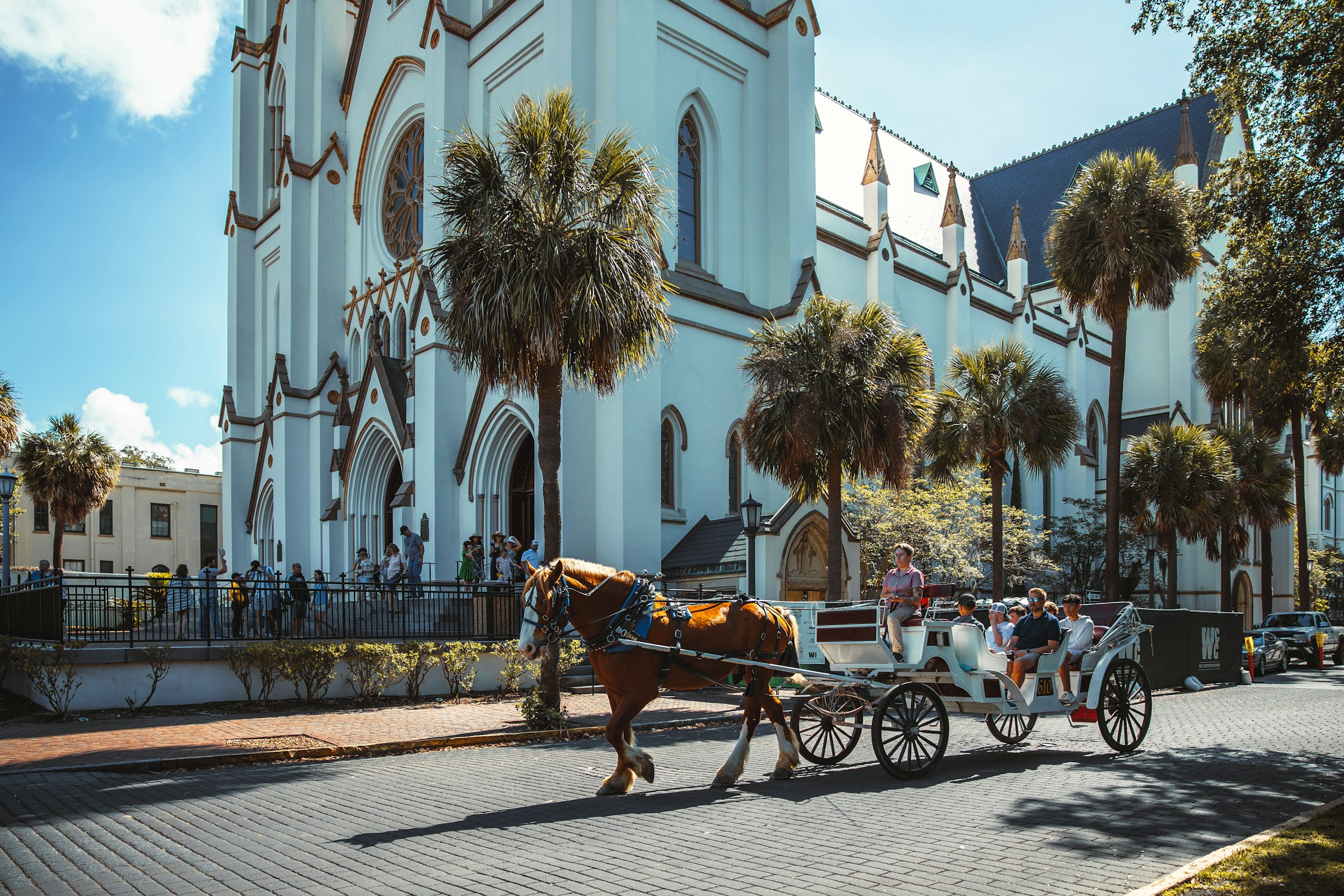

Savannah, Georgia moves at its own tempo. The city doesn’t just preserve its history – it lives inside it, day after day, in 22 green spaces that interrupt the street grid like carefully placed pauses in a long sentence. These are the squares, and no photograph ever quite does them justice.
Originally designed as part of the city’s thoughtful 18th-century layout, these gathering spaces were created to bring neighbors together, provide green refuge, and organize the growing town. The live oaks loom above brick pathways, and from every branch, Spanish moss drifts in slow curtains. Six of these squares, in particular, hold stories and atmospheres that stay with you long after you’ve left.
Johnson Square: Where Savannah Began
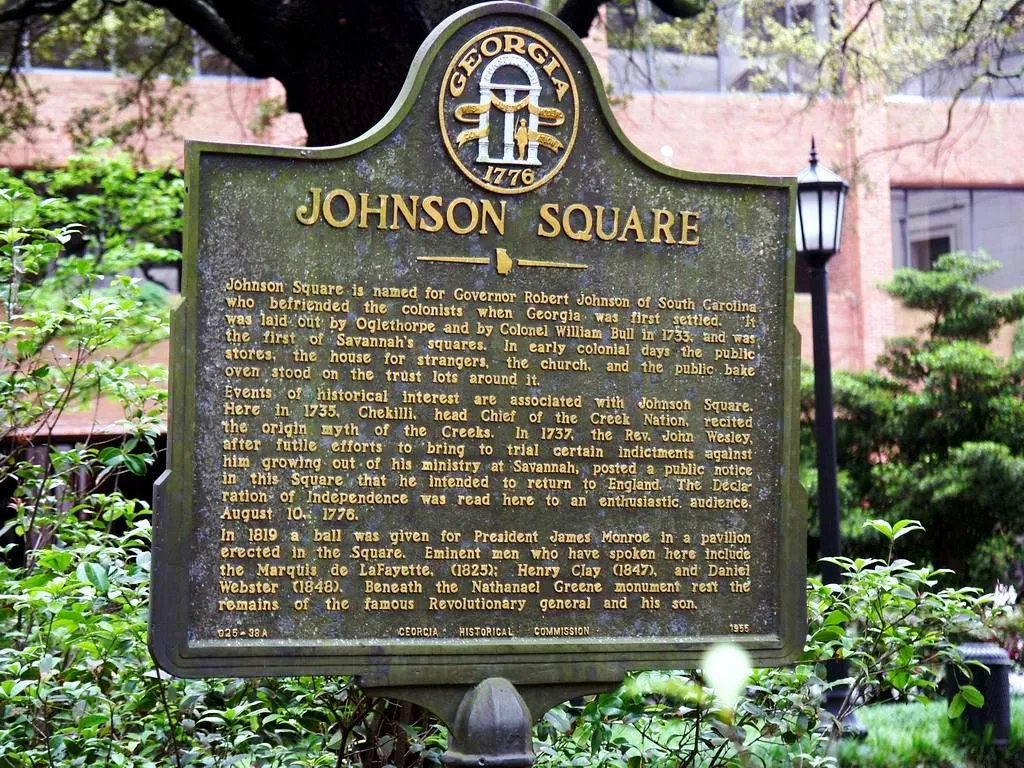
Johnson Square was designed in 1733 and named for Robert Johnson, the Royal Governor of South Carolina when Georgia was founded. It was the first of Savannah’s squares and served as its commercial hub. That original role is still readable in the landscape – surrounded by some of the most magnificent buildings downtown, including City Hall, the Christ Episcopal Church, and several large banks.
Under the Nathanael Greene Monument in the square lies Revolutionary War hero General Nathanael Greene. Standing at the center of the square today, looking up at that monument and then out at the shadowed porticos surrounding you, the weight of nearly three centuries feels almost tangible. Johnson Square lies on an axis that runs from Savannah’s City Hall down through four more squares – Wright, Chippewa, Madison, and Monterey – to the Historic District’s centerpiece, Forsyth Park.
Architect John Massengale called Savannah’s grid “the most intelligent grid in America,” and the American Society of Civil Engineers recognized it as a National Historic Civil Engineering Landmark. Johnson Square is where that story starts.
Chippewa Square: Monuments, Movies, and a Bronze General
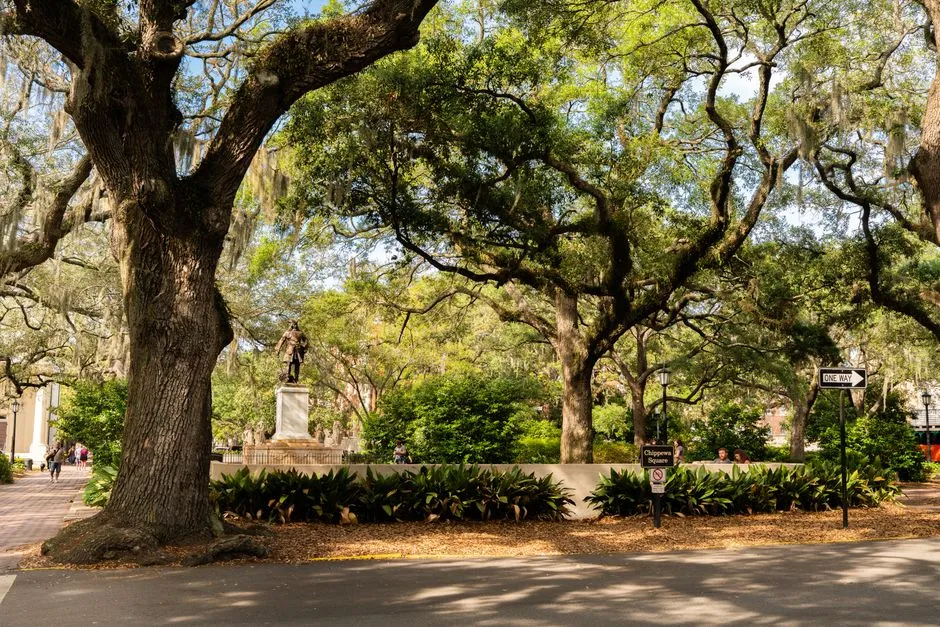
Chippewa Square was designed in 1815 and named to commemorate the Battle of Chippewa in the War of 1812. In the center stands a bronze statue of the colony’s founder, General James Edward Oglethorpe, who faces south protecting Savannah from the Spanish in Florida. The detail of his gaze direction is one of those quietly fascinating facts that reward the curious visitor.
Also known as Forrest Gump Square, the bus stop scenes from the Oscar-winning motion picture were filmed on the north end of the square. Visitors hoping to sit on the bench will unfortunately be disappointed, as it is not an original feature of the square but a prop created for the film, a copy of which can be seen in the Savannah History Museum.
First Baptist Church, on the west of Chippewa Square, is Savannah’s oldest surviving place of worship. The church received its charter in 1800. The square balances pop culture and deep civic history with a grace that feels effortless – which, in Savannah, it probably is.
Lafayette Square: Grandeur, Fountains, and Flannery O’Connor
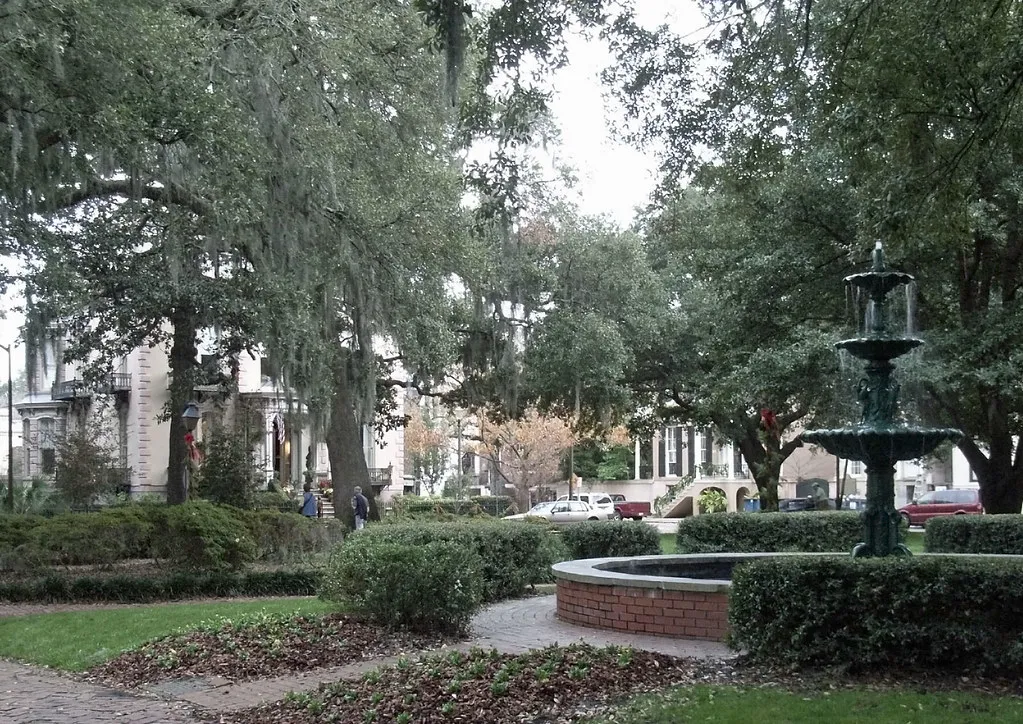
Lafayette Square was designed in 1873 to honor the Marquis de Lafayette, who aided the Americans during the Revolutionary War. The square carries a particular elegance – its brick sidewalks, mature oaks, and layered architectural context give it a sense of occasion that feels almost European.
Lafayette Square is home to the ornate Cathedral of St. John the Baptist, which has the highest twin steeples in all of downtown, designed by architect Francis Baldwin. The square also features the childhood home of the famous American writer Flannery O’Connor. That combination – a soaring Gothic cathedral on one side, a literary landmark on the other – makes Lafayette Square one of the most culturally layered spaces in the entire city.
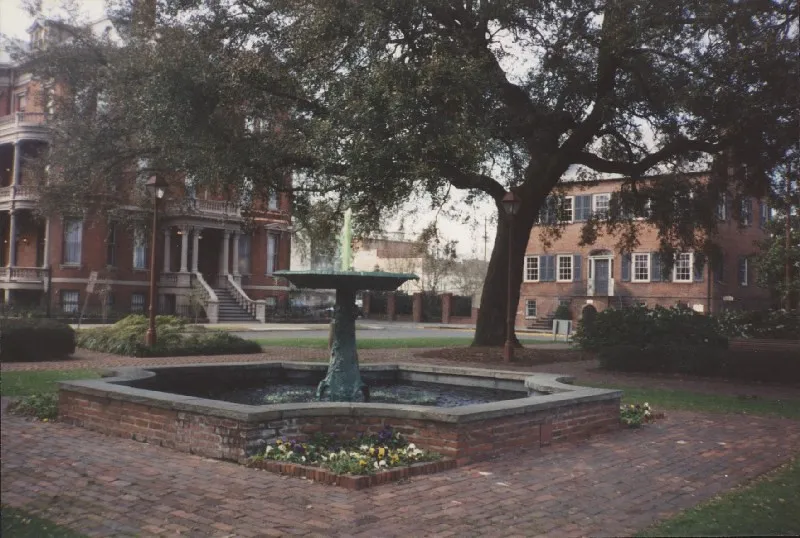
In the center sits a fountain dedicated by the Colonial Dames of America. On a quiet morning, with the light filtering through the oak canopy and the Spanish moss barely moving, this square feels genuinely cinematic without trying to be.
Madison Square: Battleground, Sherman’s Headquarters, and Ghost Stories
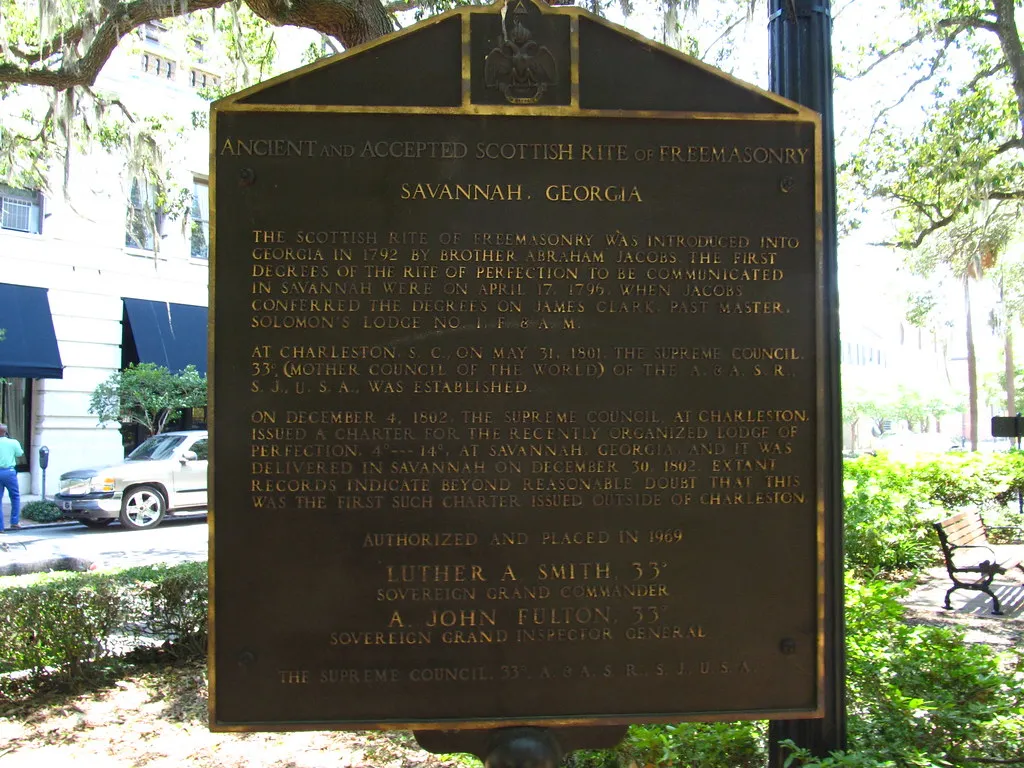
Established in 1837, Madison Square is named after the fourth president of the United States, James Madison. In the center of the square is a statue of Sergeant William Jasper, shown heroically retrieving his company’s banner even though he was mortally wounded during the Siege of Savannah. It’s a remarkably specific and human piece of commemorative history.
On Madison Square is the Green-Meldrim House, at the time of its construction the most expensive home ever built in Savannah, and later used by General Sherman as his headquarters during the Union occupation of the city. That one building alone connects the square to some of the most dramatic episodes in American history. This square was also one of the locations of fighting during the Battle of Savannah during the Revolutionary War.
There’s a plethora of history, and even some rumored hauntings, in and around Madison Square. Whether or not you believe in those stories, the atmosphere here at dusk – with the Spanish moss shifting overhead and shadows pooling beneath the oaks – makes them easy to understand.
Monterey Square: Midnight, Memory, and Mickve Israel
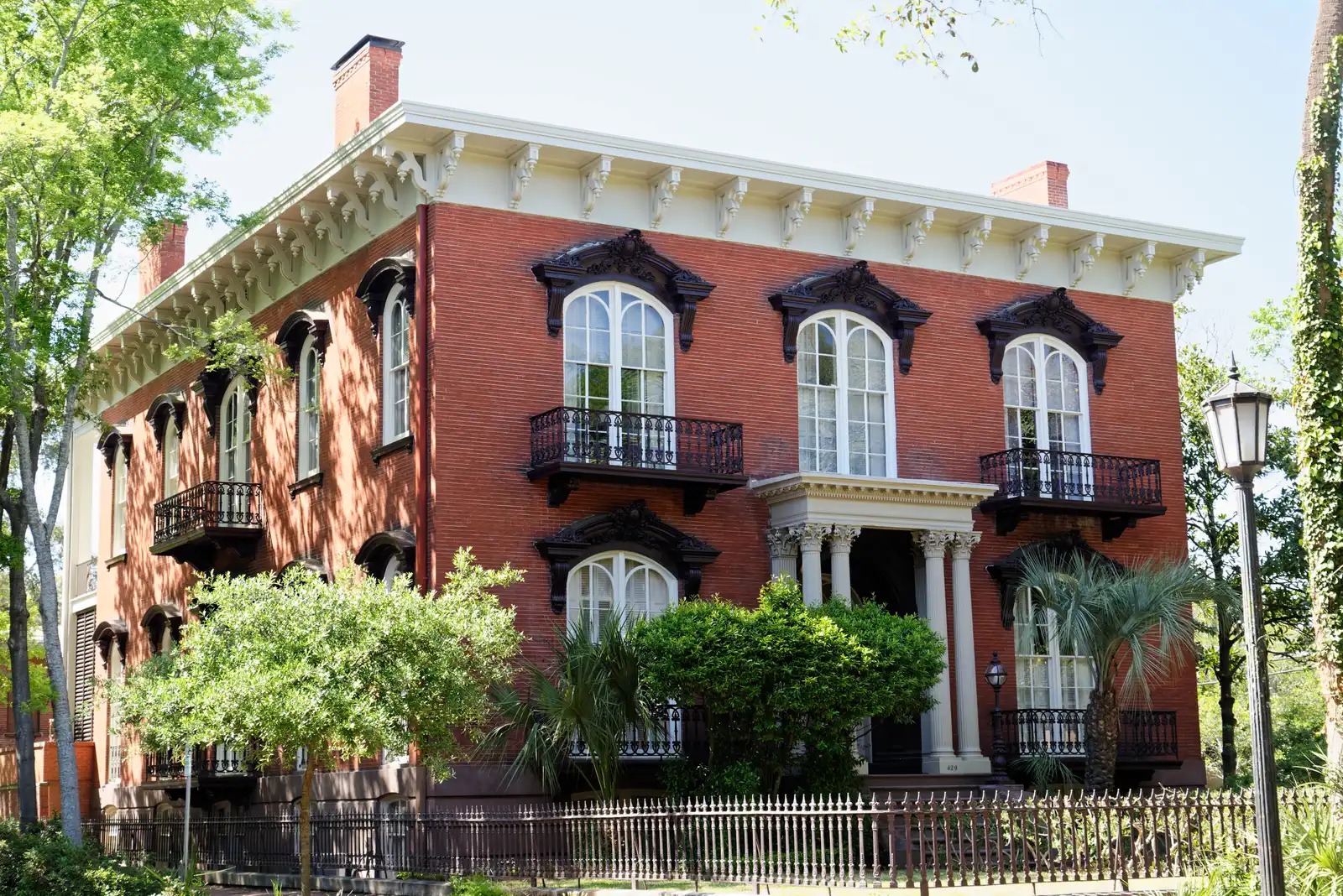
On Monterey Square are the Mercer-Williams House, famously the home of Jim Williams, subject of “Midnight in the Garden of Good and Evil,” and the Mickve Israel Synagogue, which houses one of the earliest Jewish congregations in the country. That pairing of a notorious landmark and a deeply significant religious institution makes Monterey Square feel like a microcosm of Savannah itself: layered, contradictory, and endlessly interesting.
The square’s live oaks are among the most dramatic in the city. Their limbs extend so far horizontally that the Spanish moss hangs in deep, continuous veils rather than scattered wisps. Walking beneath them in the late afternoon, when the light turns gold and the air carries the scent of warm earth, is one of Savannah’s quieter pleasures.
Bull Street, leading down from the site of the present City Hall to Forsyth Park through five of Savannah’s most beautiful squares, was a favorite promenade of the city’s wealthy in the 19th century. Monterey Square, near the southern end of that promenade, still carries that unhurried elegance.
Columbia Square: Quietude, History, and the Wormsloe Fountain
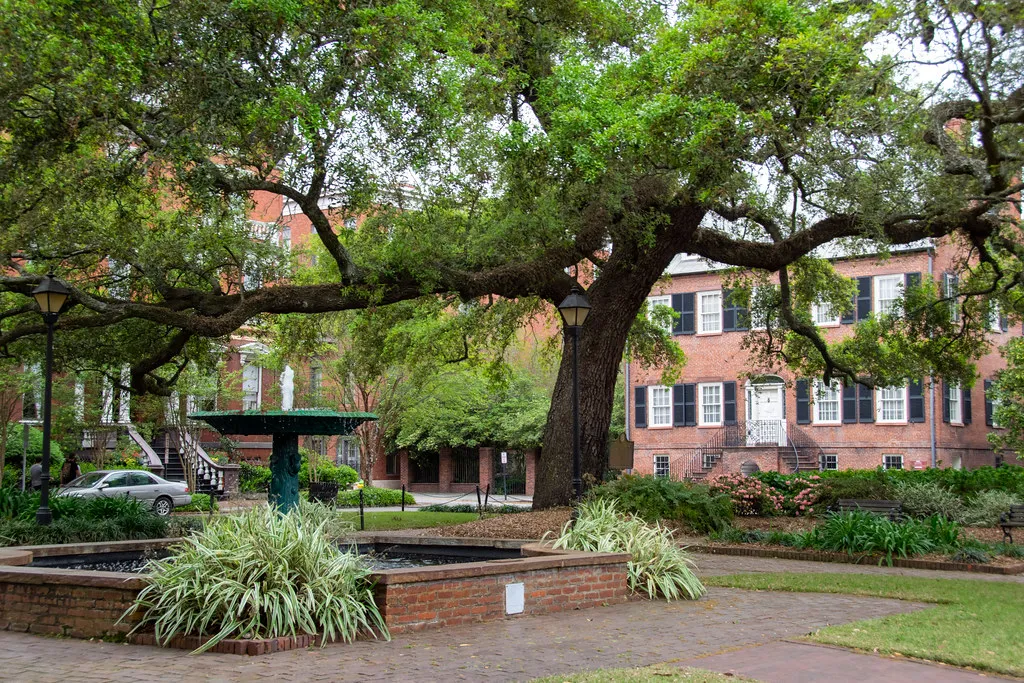
Columbia Square is a wonderfully quiet yet very historic square in Savannah, Georgia. On Columbia Square you’ll find two of the most historic homes in Savannah – the Kehoe House and the Davenport House. In the center of Columbia Square you’ll find the Wormsloe Fountain.
Columbia Square is the kind of place that rewards visitors who wander off the main Bull Street corridor. It sees fewer tour groups and more residents walking dogs or reading on benches. The Davenport House, built in 1820 and now a museum, is considered one of the finest examples of Federal-style architecture in the American South, and its preservation in the 1950s helped spark Savannah’s broader historic conservation movement.
The Spanish moss here hangs particularly thick, undisturbed by heavy foot traffic. The moss belongs to a group of plants called epiphytes, which live in the branches and trunks of trees and get everything they need from the sun and the air. Research reveals that epiphyte-draped forests play an underappreciated role in the local ecosystem by leaching dissolved organic matter into the soil, streams, and rivers during rainstorms. In a square this peaceful, that ecological relationship feels like part of the texture of the place itself.
The Science Behind the Moss: What You’re Actually Looking At
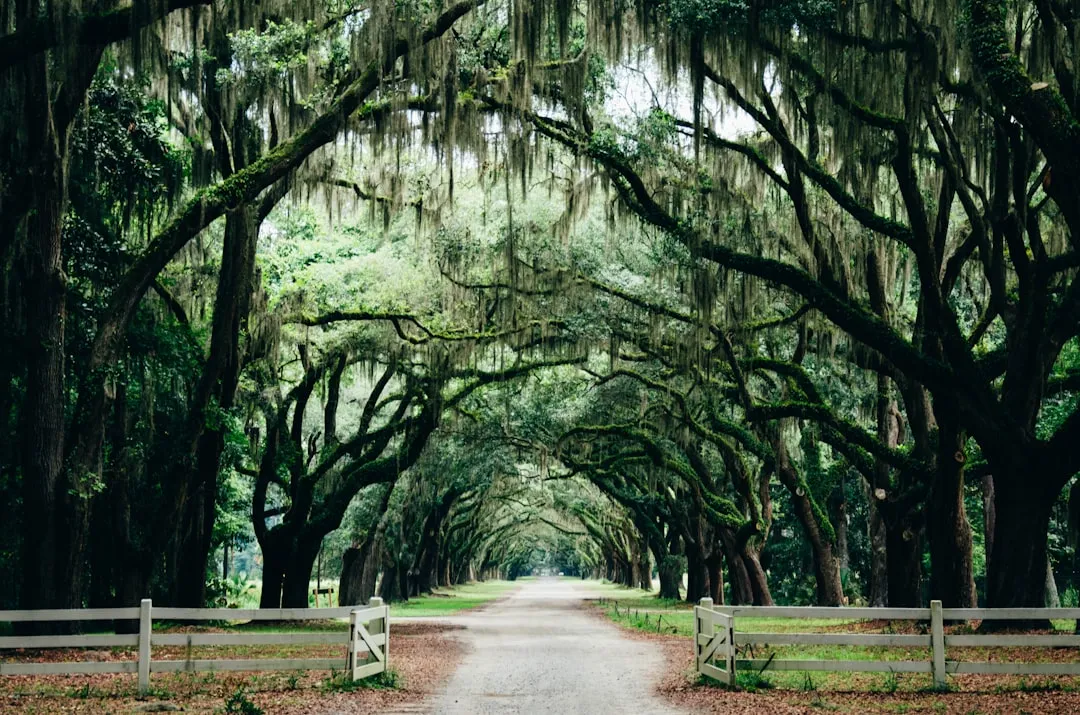
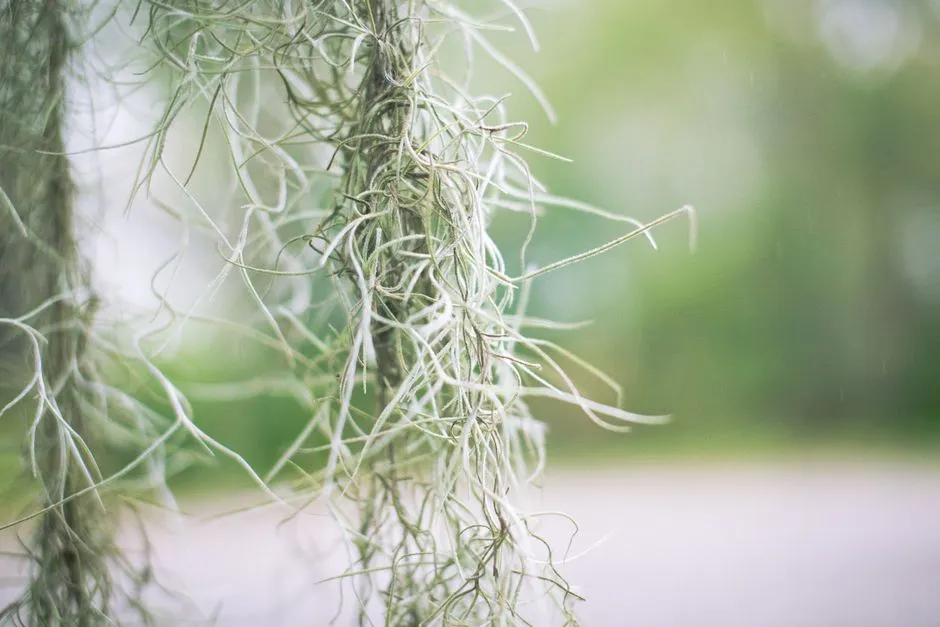
Despite its name, Spanish moss – the botanical name for which is Tillandsia usneoides – is neither a moss nor of Spanish origin. Spanish moss is a bromeliad, not a moss at all. By this classification, it’s in the same family as the pineapple rather than actual moss. That fact has a way of shifting your perspective entirely when you’re standing beneath a canopy of it.
An epiphyte rather than a parasite, Spanish moss doesn’t take nourishment from the trees. Instead, it feeds on whatever happens to be floating by – dust, fog, dead tree cells, and the bits of moisture and nutrients that collect on its tiny scales. Its leaves and stems grow pendant-style and can form hanging structures up to twenty feet long.
During the colonial era, the moss was harvested and used as stuffing for mattresses, upholstery, and even as insulation for homes. It was also used as a source of fiber for weaving baskets and other household items. Most visitors see it purely as atmosphere, but it has always been a practical part of Southern life too.
Why the Moss Doesn’t Grow Everywhere in the Squares
Not every Savannah square is draped equally, and there’s a real scientific explanation for that. As one local observer noted, pretty much none of the squares north of Broughton Street have Spanish moss, and only one south of Broughton Street does. This surprises many first-time visitors who expect the moss to be universal.
Spanish moss spreads by riding the wind, and the large buildings that line the south side of Bay Street block it from landing and taking hold in those squares a block south of Bay. It’s a reminder that what feels like pure atmosphere is actually shaped by very specific physical conditions – wind patterns, humidity, urban geography.
Spanish moss thrives in warm and humid environments, which is why Savannah’s coastal climate suits it so well. The squares where it grows most abundantly tend to be those with older, wider oak canopies and more open airflow – conditions that happen to align with some of the most historically significant spaces in the city.
How to Walk the Squares Thoughtfully
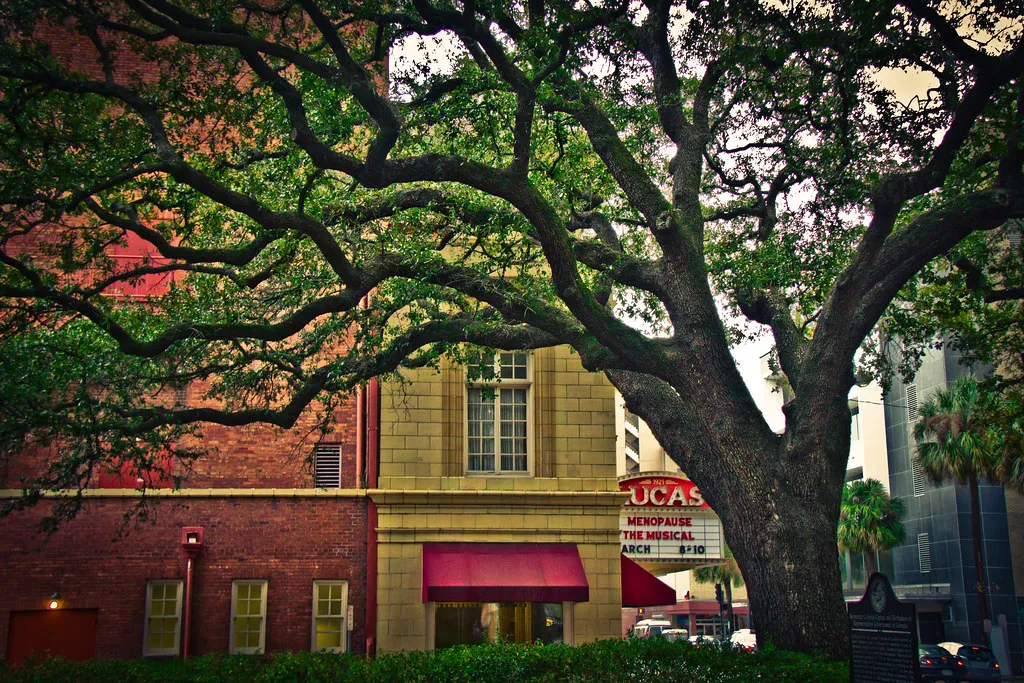
The squares of Savannah are part of the historic district and fall within an area of less than one half square mile, making it easy to see many of them on foot. That compactness is one of Savannah’s quiet gifts. You don’t need a car, a tour bus, or a rigid itinerary. A comfortable pair of shoes and a few unhurried hours will take you through centuries of history.
The squares aren’t museum pieces – they’re active, living spaces. They are where you’ll find everything from picnics and weddings to musicians, tour groups, and quiet moments beneath moss-draped oaks. Arriving early in the morning, before the crowds gather, gives you a version of these spaces that feels almost private.
Each square has a distinct character that emerges slowly. Johnson Square feels civic and ceremonial. Columbia Square feels residential and calm. Lafayette Square feels architectural and literary. Resisting the urge to rush between them, and instead sitting long enough to notice the light shifting through the oak canopy, is genuinely the best way to understand what makes Savannah different from any other American city.
The Urban Design Legacy That Still Shapes the City
General James Oglethorpe founded Savannah in 1733. The squares were not just for beauty. They were also practical – colonists used them for things like military training. That dual purpose, aesthetic and functional, is woven into the DNA of the plan itself.
In 1994, Savannah’s historic plan was even considered for the UNESCO World Heritage List. The grid has influenced urban planners for generations precisely because it solved real human problems – circulation, community, green space, orientation – without sacrificing beauty. Walking it today, that intelligence is still quietly evident.
Of the original 24 squares, 23 remain today, each anchored by monuments, statues, and shaded pathways that tell stories of Savannah’s past. The one square that was lost – paved over for a parking garage – became a catalyst for preservation advocacy that ultimately saved much of what remains. That history of near-loss makes what survives feel more precious, not less.
A City Worth Returning To
Savannah’s squares are not a checklist. They’re more like a conversation that deepens with each visit. The first time, you notice the beauty. The second time, you start reading the monuments. By the third, you realize the moss, the oaks, the brick, and the history are inseparable from each other – one continuous, layered thing.
What makes these six squares genuinely special is that they hold both grandeur and stillness at the same time. Some cities feel like they perform their history. Savannah simply inhabits it, and the Spanish moss – patient, unhurried, and very much alive – does the same.
AI Disclaimer: This article was created with the assistance of AI tools and reviewed by a human editor.