
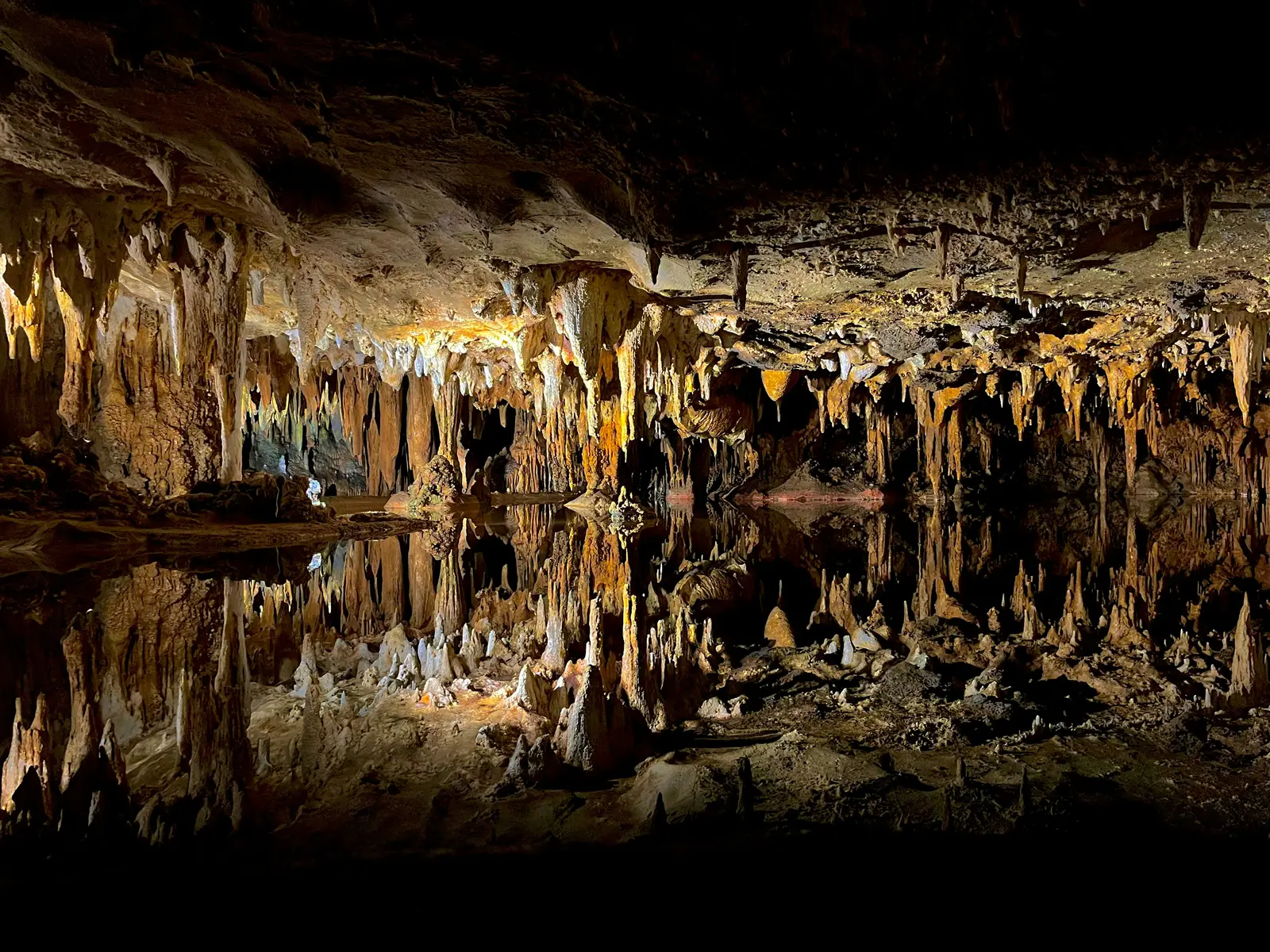

Luray Caverns in Virginia draw hundreds of thousands of visitors each year for good reason. The site ranks as the largest cavern in the Eastern United States, with chambers that reach ten stories high and formations shaped over millions of years. Its scale and pristine condition set it apart from many other cave systems travelers encounter.
A Chance Discovery That Earned Global Acclaim
Three local men first entered the caverns on August 13, 1878, after noticing a cool breeze from a hillside depression. Andrew Campbell, William Campbell, and Benton Stebbins dug for five hours before sliding inside, where they encountered the massive Washington Column. The find quickly gained attention for its extraordinary decoration. The Smithsonian Institution examined the site in 1880 and concluded that no other cave in the world matched Luray for the profusion of stalactite and stalagmite ornamentation. National Geographic later highlighted the draperies as among the finest examples anywhere. In 1974 the caverns received designation as a Registered Natural Landmark, which protects the formations from further alterations and limits exploration to designated paths.
Choosing a Self-Guided or Guided Visit
Visitors can explore on a standard self-guided tour that lasts about an hour along a paved 1.25-mile loop. The route covers roughly one-third of the system through well-lit chambers that extend across 60 acres. A booklet provided with admission points out numbered stops and offers brief descriptions of each feature. Guided Discovery Tours run about an hour as well and include early entry plus a booklet on the caverns’ story. Participants may linger afterward for additional photos. The constant 54-degree temperature makes the experience comfortable year-round, though summer visitors sometimes note higher humidity inside.
Formations That Define the Experience
Several stops stand out for their visual impact and geological interest. Dream Lake creates a striking optical illusion where ceiling stalactites reflect perfectly on the shallow water below, making the pool appear far deeper than its actual maximum of 20 inches. The Giant Redwood, a towering flowstone formation estimated at more than seven million years old, measures 40 feet high and 120 feet around. Saracen’s Tent displays some of the most delicate draperies found in any cave. The Double Column in Giant’s Hall rises 47 feet, formed by a stalactite and stalagmite that grew side by side without meeting. The Wishing Well, the deepest body of water in the caverns at six feet, collects coins that are later donated to environmental and educational causes. The Cathedral chamber once hosted dances and now houses the Great Stalacpipe Organ, the world’s largest musical instrument, which produces tones from the stalactites themselves. – Dream Lake for its mirror-like reflection
– Giant Redwood for sheer age and size
– Saracen’s Tent for world-class draperies
– Double Column for its unusual paired growth
– The Wishing Well for its depth and tradition
Additional Sites and Practical Details
A single ticket also grants access to the Shenandoah Heritage Village and Luray Valley Museum, the Car & Carriage Museum, and Toy Town Junction. Separate tickets cover the Garden Maze and Rope Adventure Park for families seeking outdoor activities. The caverns remain open every day, with hours that shift seasonally from 9 a.m. to as late as 7 p.m. in summer. Standard admission runs $36 for adults and $18 for children ages 6 to 12. The site sits in the Shenandoah Valley, roughly two hours from Washington, D.C., making it an easy addition to trips that include Skyline Drive or Shenandoah National Park. The combination of protected natural beauty and convenient access continues to draw travelers seeking an underground landscape unlike any other in the region.
AI Disclaimer: This article was created with the assistance of AI tools and reviewed by a human editor.