
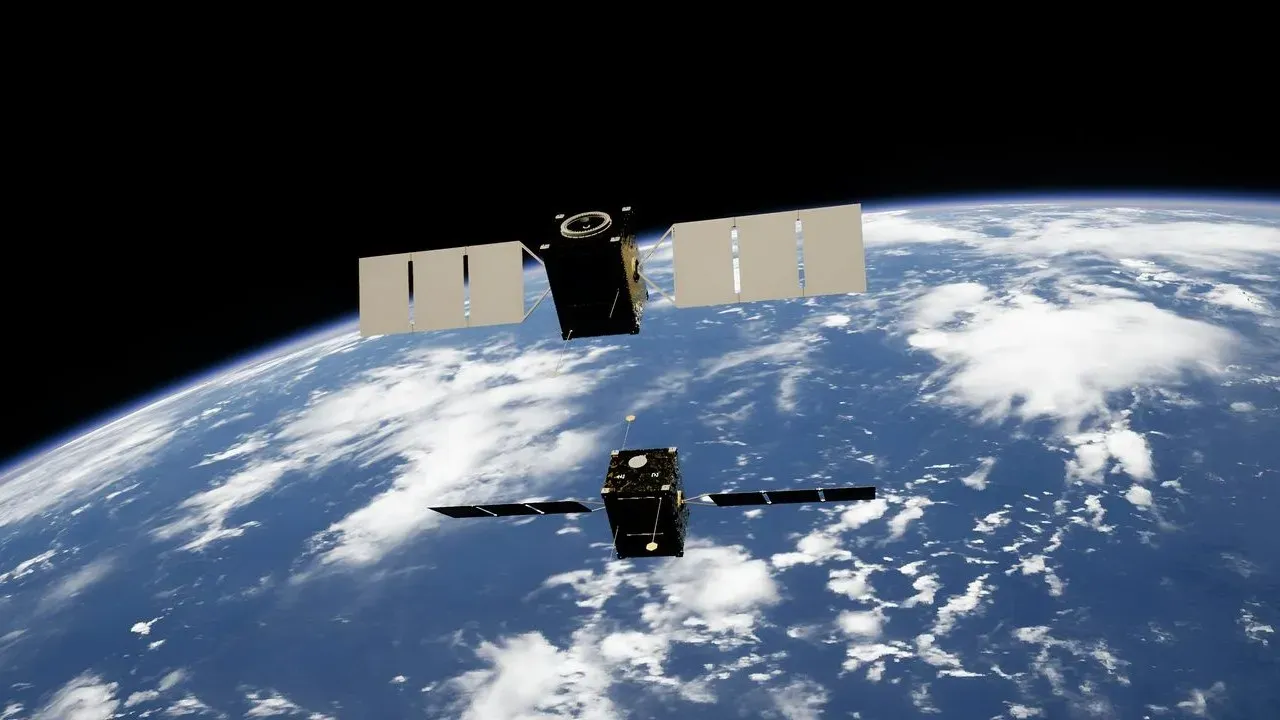

Cape Canaveral, Fla. – A compact spacecraft with three articulated arms lifted off Friday from a remote Pacific launch site, beginning a focused effort to reach and stabilize a NASA observatory that has been losing altitude. The mission targets the Swift telescope, which has orbited Earth since 2004 and now faces an accelerated descent driven by heightened solar activity. Success would restore the instrument to a safer height and allow it to resume its work observing cosmic explosions.
Swift’s Changing Orbit
Swift was designed to detect and study gamma-ray bursts and other high-energy events across the universe. In recent months, increased solar storms have expanded Earth’s upper atmosphere, creating additional drag that pulls the 1.6-ton observatory downward more rapidly than expected. At its current altitude of roughly 224 miles, the telescope risks reentry within months if no intervention occurs.
NASA has placed observations on hold to conserve the remaining fuel and orbital position. Engineers calculate that without a boost, Swift could fall back through the atmosphere as early as October. The agency therefore turned to a commercial partner for a rapid-response solution rather than accepting the loss of a still-functional observatory.
Link’s Design and Approach
Northrop Grumman launched Katalyst Space Technologies’ Link spacecraft aboard a Pegasus rocket released from a carrier aircraft over the Marshall Islands. The vehicle carries a three-armed capture system intended to gently grasp Swift and then fire its thrusters in a series of controlled burns. These burns will raise the telescope’s orbit by approximately 150 miles, returning it close to its original operational altitude.
The slow, measured thrust profile avoids any sudden forces that could damage Swift’s instruments. Once the altitude is restored, the telescope could resume scanning the sky as early as September. The entire operation was assembled in nine months to meet the narrow window before the observatory drops too low for recovery.
High Stakes and Careful Timing
Katalyst Space CEO Ghonhee Lee described the effort as a high-risk, high-reward mission, noting that the greatest danger lay in doing nothing and allowing Swift to burn up on reentry. The team worked under tight constraints, including weather and technical delays that pushed the launch date several times. Every element of the spacecraft and the rendezvous plan was shaped by the need to act before autumn.
The same solar-driven atmospheric expansion that threatens Swift also affects other satellites, including the Hubble Space Telescope. NASA has indicated that Hubble could become a candidate for a similar salvage operation in coming years, suggesting that the current mission may serve as a proof of concept for future interventions.
What Matters Now
The mission demonstrates how commercial agility can complement established space-agency programs when time is short and the scientific stakes remain high.
Engineers will monitor Link’s progress over the next several weeks as it closes the distance to Swift. If the capture and orbit-raising sequence proceeds as planned, the telescope will once again contribute data on some of the universe’s most energetic phenomena. The outcome will also inform planning for other aging observatories that continue to deliver valuable observations despite gradual orbital decay.
AI Disclaimer: This article was created with the assistance of AI tools and reviewed by a human editor.