


Where the Rule Comes From

Standing on the right is the most common convention, following early escalator design in London. The norm spread across much of the English-speaking world as urban transit systems grew through the twentieth century, and cities naturally borrowed from one another’s transit culture. Over decades, it became embedded in the rhythm of daily commuting.
In Europe and North America, escalator etiquette predominantly follows the convention of standing on the right side and walking on the left, facilitating the passage of hurried commuters while maintaining orderly flow in busy urban environments. This practice is standard in the United Kingdom, the United States, Canada, and the majority of European countries, including France, where it aligns with broader pedestrian norms of keeping to the right.
In the United States, this aligns with street traffic rules, where vehicles pass on the left, while slower vehicles stay in the right lane of the road. This approach to passing leads to the formation of pedestrian lanes of traffic. While they’re not painted on sidewalks like they are on roadways, these functional lanes can help pedestrians move more comfortably and quickly.
The Rule in Washington D.C.: The Most Serious City of All

When riding the escalator in D.C., stand to your right, walk to your left. Standing in a twosome that blocks the left side is strongly, and often loudly, discouraged by your fellow Metro riders. This is not a suggestion that gets politely ignored. D.C. commuters treat it as a basic social contract, and they will let you know if you’ve violated it.
The longest single-tier escalator in the Western Hemisphere, spanning 230 feet, is located at Metro’s deep-level Wheaton station. When you’re standing on something that long with a pack of commuters behind you, the pressure to stay right is absolutely real. On the “Metrorail Rules and Manners” page of the transit authority’s website, passengers are advised to “Stand to the right facing forward. Walk on the left.”
New York City’s Unwritten Law

The NYC escalator is a mode of transportation, not a rest stop. This is the most sacred unwritten law of the New York transit system: if you want to stand and let the machine do the work, stay on the right side. At the stations that have escalators, the etiquette is to stand on the right side and people may walk past on the left.
Midtown, especially around Grand Central or Penn Station, the escalators are a battlefield. This is the realm of the commuter – people who have a very specific, rehearsed route through the station. If you disrupt their “flow” by standing on the left, you are the personification of their morning commute frustrations.
If you block the left lane, expect the person behind you to be visibly – and possibly audibly – distressed. New Yorkers don’t usually say it with malice. They say it because the city runs on momentum, and blocking it feels almost personal.
The Science Behind the Rule: Does It Actually Work?

Users of escalators and moving walkways with sufficient space to accommodate two lanes of users often follow an implied etiquette for the two lanes: one for walking and one for standing. The assumption has long been that this two-lane system is the most efficient way to move people. As it turns out, the reality is more nuanced than the rule suggests.
A study in London found that nearly three quarters of people choose to stand instead of walking, especially on the longer escalators. With the “stand on the right, walk on the left” rule, roughly half the space on escalators is being reserved for only about a quarter of commuters. That is a significant imbalance, and it becomes a real problem when stations are busy.
A 2024 transit study found that in very high-congestion scenarios, having everyone stand on both sides of an escalator can actually move more people per minute than the walk-left system because it eliminates the bottleneck created by one unused lane. This is counterintuitive but well-supported in the research literature.
The London Experiment That Changed the Conversation

In November and December of 2015, Transport for London conducted a three-week trial at Holborn station to test whether encouraging passengers to stand on both sides of escalators could increase capacity during peak hours. The results were striking and sparked a global conversation about what “good” escalator behavior actually looks like.
By making them standing-only, the test showed 16,220 people could travel on Holborn’s 23.4-meter-high escalators during rush hour, compared to 12,745 in normal circumstances. The average time to move from the platform to the top of the escalators when everyone stood on both sides was 59 seconds, 13 seconds slower for those who normally walked, but 79 seconds faster for standers. The average length of escalator boarding lines decreased from 73 people to 24 people.
The maximum throughput observed was 141 passengers per minute on standing-only escalators compared to 115 passengers per minute on walk-left escalators during peak congestion. The numbers are clear, yet commuters resisted. Commuters pushed back, calling the trial “stupid.” Habits, it seems, are harder to shift than data alone might suggest.
University Research Adds More Weight

Using deterministic queueing models that considered both system and individual objectives to analyze various scenarios of walkers and standers, the analysis concludes that the best way to clear a busy platform during rush hour is to allow everyone to access both lanes of an escalator, regardless of their desire to walk or stand. This research, published in the journal Systems in June 2024, brings a fresh academic perspective to a debate that has long been driven more by habit than evidence.
Researchers suggest that transit systems could use a signaling system to indicate lanes in use for walkers and standers that could change based on rush hour capacities, like the signals used on many roads and bridges that change direction based on rush hours. That kind of flexible, data-driven approach might eventually bridge the gap between what science recommends and what commuters are willing to do.
Safety Is a Bigger Factor Than Most Realize

Escalator steps are taller and steeper than regular stair steps, and walking on them, especially while rushing or squeezing past someone, does carry more risk than walking on a standard staircase. The U.S. Consumer Product Safety Commission recommends standing in the center of the step and holding the handrail. They found that escalators account for around 10,000 emergency-room injuries in the U.S. annually, and a notable portion of those are associated with walking on the escalator itself.
A study in Tokyo found almost 60 percent of escalator accidents between 2013 and 2014 resulted from people using escalators improperly, which includes people walking or running on them. That is a meaningful share of incidents tied directly to behavior that many commuters consider totally routine. Walking on moving steps increases the risk of trips, falls, and getting caught, especially in crowded areas or when carrying items.
How It Differs Around the World

Different regions follow different conventions: London, Hong Kong, and Osaka follow the stand-right/walk-left pattern, while in Japan outside the Kansai region, Malaysia, Singapore, Australia, and New Zealand, riders stand on the left and walk on the right. These regional differences have deep local roots, and they can trip up even experienced travelers.
In Japan, escalator etiquette is key: stand left and walk right in Tokyo, but reverse it in Osaka. In Osaka, the practice of standing on the right began in 1967 with the installation of a new escalator at Umeda Station. An announcement instructed passengers to “keep the left side open,” which was inspired by practices observed in London. This guideline became the norm in Osaka.
In mainland China, authorities as of July 2025 have campaigned to abandon the walk-left practice in favor of standing on both sides to enhance safety and capacity, citing reduced accident risks in high-density environments. The global picture is genuinely varied, and no single rule holds everywhere.
When the Rule Is Being Challenged at Home

In the 21st century, there have been campaigns for standing on both sides for reasons of safety or to increase capacity. These campaigns have appeared in cities including Toronto and Washington D.C., though changing deeply ingrained habits has proven difficult. The morning rush hour crowd does not easily give up a ritual built over decades.
The approach asks people to do something they are often bad at: delaying instant gratification in the interest of a greater good. A lot of the benefit of universal standing has to do with reducing the bottleneck at the entrance to escalators. The more people can get on per minute, the less time they have to wait to get on in the first place. For most walkers, though, that trade-off doesn’t feel worth it in the moment.
What This Means If You’re Visiting a Big City

The practical advice for any visitor is simple: when in doubt, move to the right and stay there. Escalator norms vary by country. In many parts of Asia, convention is the opposite of what it is in the U.S., and some cities have been moving toward standing-only escalators entirely. If you’re traveling, read the room, or the signage, before confidently striding up the left side.
Observe what everyone around you is doing before committing to a lane. Following regional rules keeps traffic flowing smoothly and shows respect – just observe and go with the flow. That spirit of respectful awareness is really at the heart of good transit etiquette everywhere, not just on escalators.
Carrying luggage adds another layer of consideration. Keep bags close to avoid tripping hazards. A rolling suitcase parked sideways on an escalator step is one of the quickest ways to earn a hard stare from a commuter who has somewhere to be.
The Bigger Picture of Urban Flow

The stand-right rule is really a small expression of something larger: the way dense cities self-organize around shared, unspoken agreements. Human systems engineers know that pedestrian lanes emerge naturally in crowded environments. What looks like spontaneous courtesy is often deeply logical behavior that evolved to handle the physics of crowds.
While using one of the escalator lanes for walking can help the walking pedestrian exit more quickly, walkers’ varied speeds relative to the rest of the traffic hinders overall efficiency. The system as a whole absorbs the cost of individual impatience. That tension, between personal efficiency and collective flow, is really what the escalator rule is about.
Cities are complex, and the best travelers move through them lightly. Knowing a rule like this one is a small but genuine act of respect toward the people who navigate these spaces every day of their working lives.
The Takeaway
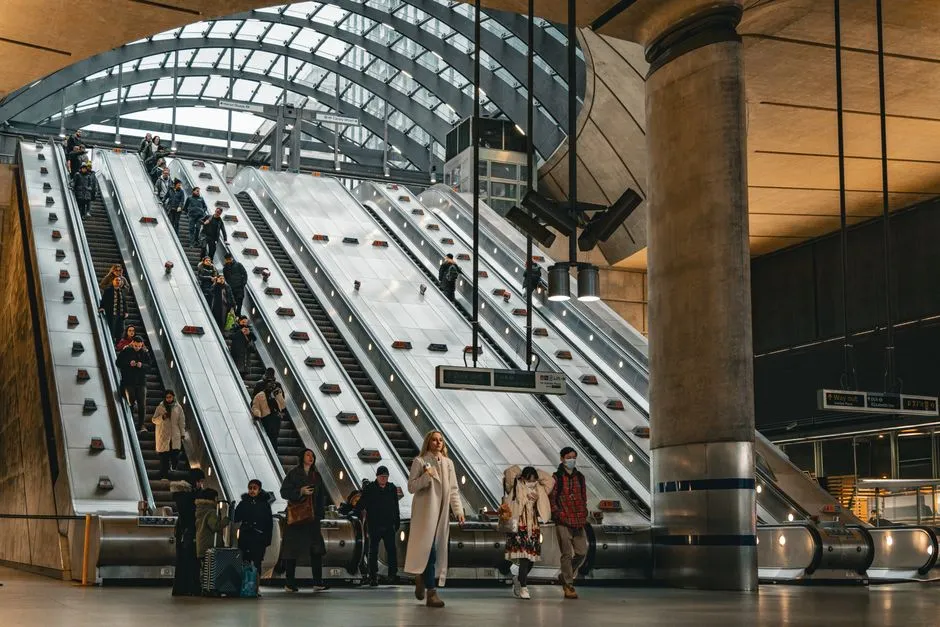
Stand right, walk left. It’s a short rule with a surprisingly long history behind it, backed by everything from transit authority guidelines to peer-reviewed queueing models. The science on mass efficiency points in one direction, the culture of daily commuting points in another, and somewhere between the two sits the practical reality of getting people up a moving staircase without conflict.
For visitors, the most useful thing to know is that this rule feels deeply personal to the people who live by it. Following it is less about avoiding a fine and more about moving through a city with the kind of awareness that makes shared space work. That, more than anything, is what experienced urban travelers carry with them from city to city.
AI Disclaimer: This article was created with the assistance of AI tools and reviewed by a human editor.