
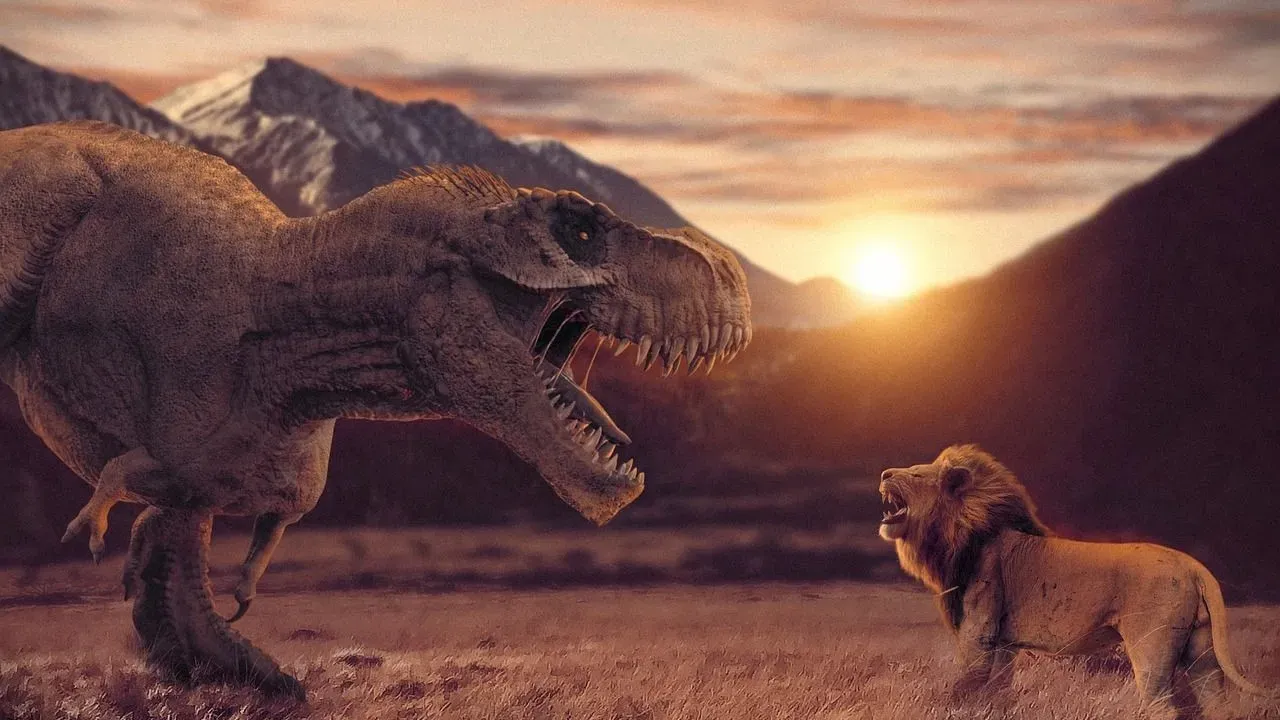

Deep in the badlands of western North Dakota, a chance discovery has given scientists their first clear look at how an adult Tyrannosaurus rex moved across its ancient landscape. The find centers on a short but telling sequence of footprints that preserves a moment of quiet locomotion from roughly 66.5 million years ago. For anyone who has ever wondered whether a person could simply walk away from the famous predator, the evidence now points to a clear answer. ([1])
The 23-foot trail was uncovered last summer on a slope within the Hell Creek Formation near Marmarth. It consists of four well-preserved prints spaced about 13 feet apart, each showing the distinctive three-toed shape of a large theropod. The trackway is the first of its kind documented for an adult T. rex, offering direct behavioral data rather than inferences drawn solely from bones.
A Teacher’s Unexpected Find
Kent Hups, a Colorado high school science teacher and volunteer research associate with the Denver Museum of Nature & Science, spotted the prints while working on a research expedition in July 2025. His initial reaction was one of complete surprise. “My first reaction was total disbelief,” Hups recalled. He sat with the tracks for some time before accepting what he was seeing.
Hups has long encouraged his students to approach science through curiosity and careful observation. The discovery reinforced that message in the most tangible way possible. What began as routine fieldwork quickly became a contribution to the broader understanding of one of the most studied dinosaurs in the fossil record.
Calculating an Ancient Walking Speed
With a continuous trail in hand, researchers could move beyond estimates based on skeletal proportions alone. Paleontologist Scott Persons noted that a sequence of tracks allows scientists to calculate how fast the animal was traveling. Using the spacing of the prints and the estimated leg length of the dinosaur, the team arrived at a walking speed of nearly 1.6 miles per hour.
That pace is slower than a typical human stroll. For a person in average physical condition, maintaining a comfortable walking speed would have been enough to stay ahead of the dinosaur. The trackway therefore supplies the first direct evidence that an adult T. rex moved at a measured, energy-efficient gait rather than a constant predatory sprint.
Why Trackways Matter
Dr. Tyler Lyson, senior curator of vertebrate paleontology at the Denver Museum of Nature & Science, emphasized the rarity of such finds. Bones reveal anatomy and growth patterns, yet footprints capture a living animal in motion. A trackway lets researchers follow that movement across the landscape in a way no skeleton can.
The Marmarth discovery adds a new dimension to studies of T. rex behavior. It shows the animal traversing open terrain at a deliberate speed, consistent with foraging or traveling between resource patches rather than actively chasing prey. The findings were detailed in a paper published in the Journal of Vertebrate Paleontology on September 8.
Visiting Dinosaur Country
Places like the Hell Creek Formation continue to draw visitors interested in deep time and the stories preserved in stone. Guided tours, museum exhibits, and public dig programs in western North Dakota and eastern Montana offer opportunities to see similar landscapes and learn directly from paleontologists. Travelers who approach these sites with respect for the land and its scientific value often come away with a deeper appreciation for the slow, patient work of discovery.
The new trackway stands as a reminder that even the most iconic predators left behind moments of ordinary movement. For those planning a trip to fossil-rich regions, the experience can be both humbling and inspiring, connecting modern curiosity with evidence that has waited millions of years to be read.
AI Disclaimer: This article was created with the assistance of AI tools and reviewed by a human editor.