
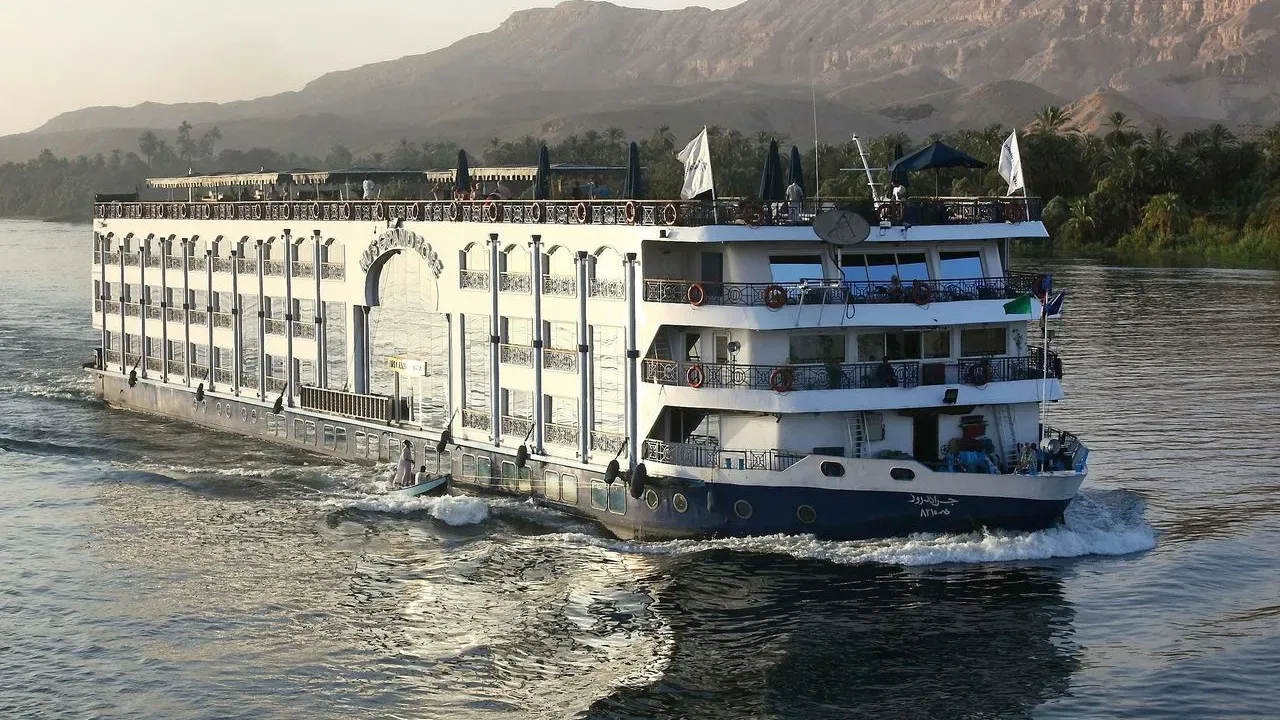

Most Nile cruises begin in Luxor, not Cairo. Viking has now scheduled a 19-night voyage that follows the full 600-mile course of the river from the capital in the north to Aswan in the south, a route that few travelers have been able to sail in one continuous trip for decades. ([1])
A route older than the modern cruise
The idea behind the itinerary is not new. In the late 1800s, paddle steamers carried travelers from Cairo south to Luxor, a distance of about 465 miles, and then continued on to Aswan. Luxor is home to some of ancient Egypt’s most famous temples and burial grounds, so the trip offered a steady sequence of monuments from start to finish.
Writer Agatha Christie took one of these long journeys in 1933 aboard the luxury paddle steamer S.S. Sudan, operated by Thomas Cook & Son. The experience later informed her 1937 novel, “Death on the Nile,” which kept the river’s long passage firmly in the public imagination.
The stretch most travelers never see
Today, the first 465 miles of that historic corridor are rarely part of a standard sailing. Ships typically travel only the roughly 130 miles between Luxor and Aswan, and guests usually fly from Cairo to Luxor after a few days in the capital. The Grand Nile Journeys reverse that pattern by letting guests move through the northern reaches of the river by water.
Along the Cairo-to-Luxor section, the itinerary includes several sites that are rarely reached on conventional trips:
- The Meidum Pyramid near Beni Suef, which dates to about 4,600 years ago
- The cliffside Noble Tombs of Beni Hasan
- Tell el-Amarna, the once-lost royal desert capital founded by the Pharaoh Akhenaten
- The Abydos Temple, known for drawings of ancient pilgrims to the sacred Festival of Osiris
After about a week on this quieter stretch, the ship reaches Luxor. The second half of the voyage then heads south through the better-known sites, including the temples of Luxor and Karnak, the Valley of the Kings, the Temple of Horus at Edfu and the Temple of Philae near Aswan.
Why the long sailings went quiet
The reason long Nile journeys became rare has less to do with demand than with circumstances on the river. In 1994, the Egyptian government officially closed the Cairo-to-Luxor stretch to overnight passenger ships because of security concerns. Low water levels and shifting sandbars also made navigation difficult.
The route did not return for nearly two decades. In 2012, after extensive river dredging, irrigation upgrades and major security overhauls, the government reopened the Cairo-to-Luxor section to cruise vessels. Even so, full sailings from Cairo to Aswan have been slow to return. Only a handful of operators now offer itineraries of this length. Movenpick Hotels & Resorts, for example, runs 14-night sailings between Cairo and Aswan on its 52-cabin MS Darakum.
Days in Cairo before and after the river
The voyage opens and closes in the Egyptian capital. Guests spend three nights at a luxury hotel in Cairo, often the Fairmont Nile City along the riverbank, before boarding Viking Ra, the line’s all-suite vessel, for the 14-night journey south. The first days in Cairo include visits to the Great Pyramids of Giza, the Great Sphinx and the Grand Egyptian Museum. A final night in Cairo follows the return from Aswan.
Travelers who want more time can add optional land programs before or after the cruise. These include two extra nights in Cairo and a four-night guided excursion to Jordan, with stops at the Dead Sea, Petra and Amman. The Grand Nile Journeys begin in 2028, and bookings are open now.
Few places offer a way to follow a single river through thousands of years of history. For travelers willing to slow down, this itinerary gives the Nile its full length, from the pyramids near Cairo to the temples at Aswan, and allows the river itself to set the pace.
AI Disclaimer: This article was created with the assistance of AI tools and reviewed by a human editor.