
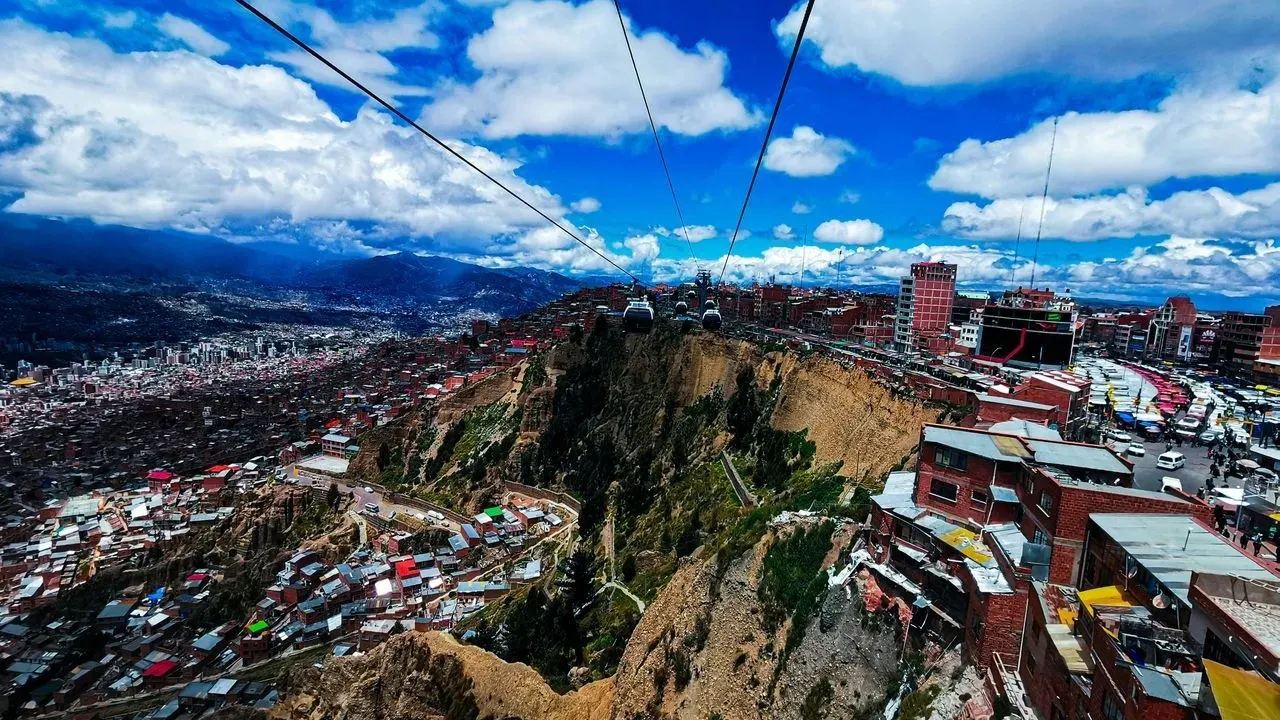

Few cities seem to defy geography the way La Paz does. It fills a bowl on Bolivia’s high plateau, with its sister city El Alto perched on the rim above. The original travel guide from Indie Traveller ([1]) captures the mix of disbelief and delight many visitors feel on first sight. La Paz serves as the seat of government, while Sucre holds the country’s constitutional capital status.
A City Built Into a Canyon
La Paz does not spread across open ground so much as it climb the walls of a canyon. The Choqueyapu River carved that valley, and water running off these slopes eventually drains toward the Amazon basin. La Paz is built in a canyon carved out by the Choqueyapu River and is a drainage basin of the Amazon River.
Elevation also shapes the weather. Summers usually bring the rain, while winters stay dry, an unusual pattern for a city so high in the Andes. Due to its altitude, the city has an unusual subtropical highland climate, with rainy summers and dry winters. Visitors who wander the lower neighborhoods and then climb back up quickly see how the terrain dictates daily life here.
El Alto, the High Neighbor
El Alto, whose name is often translated as “The High One,” rises above the canyon. El Alto is today one of Bolivia’s fastest-growing urban centers, with an estimated population of 943,558 in 2020.
A cable car network opened in 2014 now carries commuters and visitors between the two cities. The system stretches across roughly ten lines and more than thirty kilometers of cable. Mi Teleférico’s Red Line climbs from central La Paz to El Alto in about ten minutes, gaining roughly 400 vertical metres. The ride is practical transport, but the windows also offer an unhurried look at the canyon from above.
The stations reflect the people who use them. Due to the large Aymara population living in and around La Paz and El Alto, all of the cable car stations have both Spanish and Aymara names.
Reading the Altitude Before the First Day
Published figures for La Paz vary because the city does not sit at a single height. The historic centre around Plaza Murillo sits at roughly 3,640 m above sea level, while the city drops to about 3,250 m in the southern Zona Sur and rises to about 4,150 m in the adjoining city of El Alto. The original guide offers about 3,900 meters as a general figure, a point that falls within the range visitors actually experience.
Many arrivals notice the altitude before they reach the city. El Alto International Airport (LPB) is at 4,061 m, and Wikipedia registers it as the highest international airport in the world. Even everyday tasks change at this height. Water boils at 88°C (190F) in La Paz, which makes a cup of tea a little quicker to prepare.
| Area | Approximate elevation |
|---|---|
| Zona Sur | 3,250 to 3,400 m |
| Historic center (Plaza Murillo) | About 3,640 m |
| El Alto International Airport | 4,061 m |
| El Alto city | About 4,150 m |
A measured start helps travelers settle in. Several habits are worth keeping in mind during the first days:
- Keep the opening day light, with a slow walk, a long lunch and no steep climbs.
- Drink water steadily and go easy on alcohol.
- Speak with a doctor before travel, especially if you have heart or lung conditions.
- Learn the early signs of altitude sickness, and seek medical care if symptoms worsen or do not ease with rest.
- Use the cable car or a taxi for steep routes between neighborhoods.
Respect in a City of Many Voices
Mount Illimani rises on the horizon, and the Indie Traveller guide describes it as sacred. View towards Mount Illimani from El Alto is one of the most recognizable vantage points for the peak. For many Andean communities, mountains like this one carry spiritual meaning, so visitors do well to treat them with the same care they would bring to a shrine.
The city’s rhythm owes much to Aymara and other Indigenous communities whose markets, neighborhoods and daily routines give La Paz its character. Visitors who ask before photographing people, pay fair prices at local markets and listen more than they speak tend to have richer conversations. Those small choices matter as much as any sight on a list.
For travelers willing to slow down, La Paz offers a rare pairing of dramatic setting and everyday life. A canyon, a sister city above and a mountain that still anchors the skyline make the city memorable. The pace it asks for is part of what makes the experience rewarding.
AI Disclaimer: This article was created with the assistance of AI tools and reviewed by a human editor.