
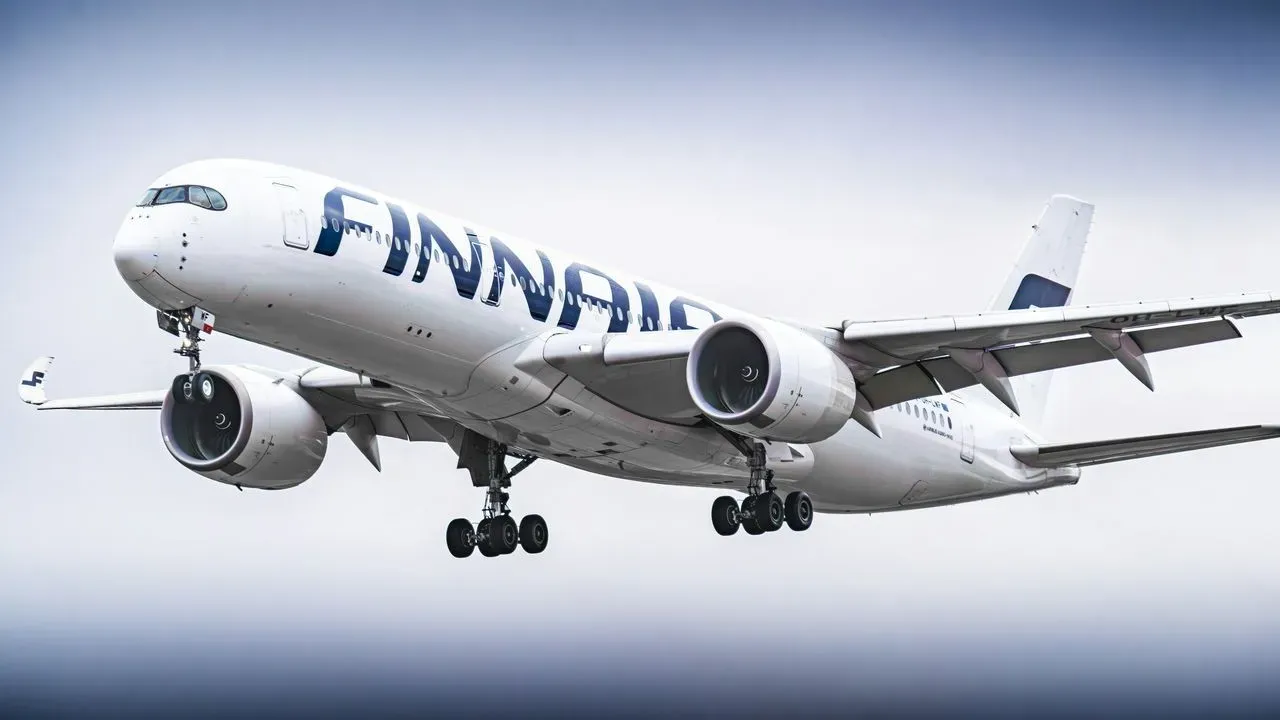

Some airlines make passengers feel they have arrived before the wheels leave the ground. Finnair applies that idea to its long-haul business class, using design and cuisine to carry a sense of Helsinki across the Atlantic. A detailed review of several Los Angeles to Helsinki round trips ([1]) shows how the seats, bedding, electronics and menus all draw on Finnish design.
A seat shaped like a sculpted bench
The AirLounge seat was developed through a multiyear investment that the reviewer describes as roughly $230 million. Collins Aerospace designed it, and its contoured shell and padded interior recall the curved birch furniture of Alvar Aalto. Its approach differs from the recline-based designs found on many business-class cabins.
No seatback reclines here. To move toward a flat bed, passengers raise a legrest that meets the ottoman, using a small button on the armrest. A lumbar pillow and a slumber pillow support a range of positions, and the reviewer found the arrangement comfortable enough to sit cross-legged. Without bulky motors to hide, the ottoman feels wider than is typical, and the reviewer reported a clear 18 inches between the shell and the row ahead, which made getting in and out easy.
Those who prefer closing doors for privacy will find that trade-off noticeable. The reviewer, who usually works and dines upright on long flights, said the high shell offered enough separation that a door was not missed.
Marimekko prints and birch-toned finishes
The Finnish influence continues in the materials. The rounded tray table and wide armrest carry a light woodgrain finish that resembles birch furniture in a Finnish home. Inside the seat, the design feels calm rather than stark, which suits a long overnight crossing.
Bedding is where the cabin becomes most personal. Duvets and pillows carry the Marimekko name and feature Maija Isola’s wavy osprey-inspired Kalasääski print. The amenity kits, made from recycled polyester, are also designed by the Helsinki house, as are the eye masks. Skincare from the Finnish brand Sees is kept in the lavatory to reduce individual packaging, and the airline does not provide pajamas. Marimekko’s partnership extends to the outside of the aircraft as well, with one Airbus A330 wearing the Unikko poppy print and one A350 displaying the Kivet design.
Charging, lighting and a sky over Lapland
The seat’s electronics are discreet but well considered. Among the features the reviewer noted:
- A wireless charging pad built into the armrest
- USB-A and USB-C ports in a shallow compartment that blends into the seatback
- A leg-level storage bin large enough for a small laptop, with a universal power plug beside it
- An 18-inch touchscreen with a slim profile
The cabin lighting may be the most memorable detail. Finnair’s A350s use a system designed to ease jet lag through gentle ambient shifts. Shortly after meal service, when many passengers settle in to sleep, the lights take on the look of the northern lights, moving from blue to green, yellow and magenta. The effect, the reviewer wrote, felt like a glimpse of Lapland winter skies.
Dishes shaped by the Nordic seasons
Finnair’s menus change with the season and draw on classic Nordic ingredients, often with an international twist. The reviewer chose braised beef short rib on the outbound flight, describing it as hearty without being greasy. On the return, a broiled rainbow trout from the Finnish Archipelago, served with smoked freshwater vendace, barley and dill potatoes, stood out. Dessert was strawberry cake with rhubarb compote, paired with a cloudberry wine from Ainoa Winery in Hollola, which the reviewer said felt like a last taste of the northern summer.
Tableware carries its own design history. Finnair still serves predeparture drinks in Ultima Thule glassware, designed by Tapio Wirkkala for the airline in 1968, and the menu includes the airline’s signature blueberry juice. The newer Kuulas line of dishes and glassware, created by Harri Koskinen for the 2022 launch of business class and premium economy, has simple round plates and a blue glass with raindrop-like indentations. The reviewer later spotted the same designs at the Iittala flagship store on Helsinki’s Esplanadi.
Helsinki as the first stop on a wider journey
For American travelers, the cabin is only part of the story. Finnair now connects Helsinki with seven North American gateways, including New York JFK, Dallas Fort Worth, Los Angeles, Chicago O’Hare, Seattle, Miami and, from May 2026, Toronto ([2]). The airline’s North American general manager has said that about half of its North American passengers choose Helsinki as their final destination, a sign that the Finnish capital draws visitors in its own right.
Finnair’s transatlantic history is longer than its current cabin design. The airline first reached the United States in 1969 with service to New York, and the JFK route remains a core part of its network ([2]). For travelers heading to Europe from the United States, the business-class cabin offers a thoughtful preview of Nordic design, from the seat that doubles as a bed to the dishes served before departure. The trip, in this sense, begins before the aircraft lands.
AI Disclaimer: This article was created with the assistance of AI tools and reviewed by a human editor.