
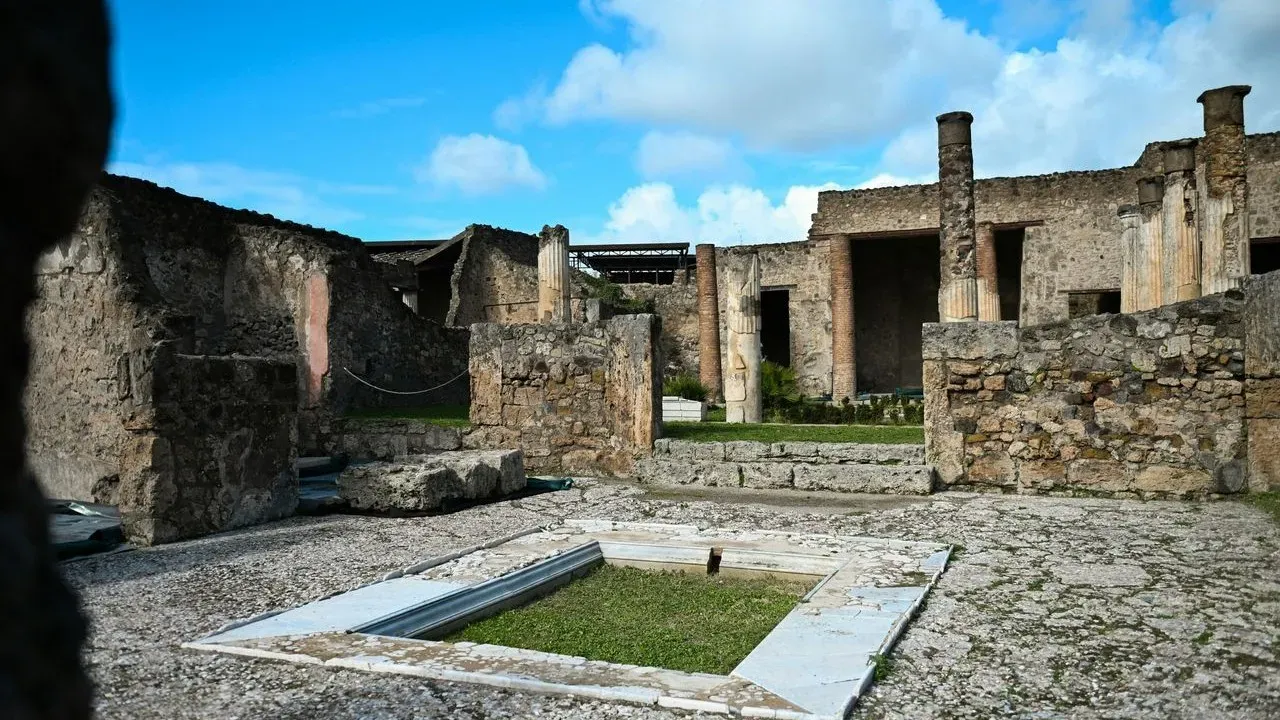

Pompeii, Italy – Archaeologists working in one of the ancient city’s busiest districts have recovered the traces of a household cabinet that no one reopened after Mount Vesuvius buried Pompeii in 79 CE. The objects inside, including coins, cosmetics and a child’s charm necklace, offer an unusually personal view of daily life in a Roman home. The find, announced by the Pompeii Archaeological Park, adds to a series of recent discoveries at the site. The original report is available at ([1]).
A Wooden Cabinet Preserved in Volcanic Ash
The house, known as House IX 11, 7, faces Via dell’Abbondanza, one of the main thoroughfares of the ancient city. Its facade was first excavated in 1912, while the rooms behind it have only recently been investigated as part of a broader restoration project ([2]). The house is tentatively linked to a man named Cornelius Maximus, based on inscriptions that have since faded.
The wood of the cabinet itself did not survive the centuries. Instead, the excavation team read the cabinet’s shape from the impression it left in the volcanic deposits, then used those clues to reconstruct its original form. The cabinet was partly buried when the ash and pyroclastic material arrived, which helped preserve more than half of its height. Officials said the reconstruction made it possible to match each object to the place where it had been stored.
Small Objects, Large Stories
The contents point to a household that valued both practical goods and personal memories. Researchers describe the following finds:
- 38 bronze coins stored in a small woven basket called a cistella, with 36 of them dating to the reign of Nero, according to one report ([5])
- A glass perfume or ointment bottle, bronze tweezers and a slate slab used to grind pigments, the Roman equivalent of a makeup palette
- An incense burner, a bronze lamp and lead weights, which suggest someone in the household may have been involved in trade
- Bronze, glass and ceramic pots and pans stacked on the shelves
- A necklace of at least 24 miniature charms made of faience, bone, glass paste and rock crystal
The charms are particularly striking. They depict deities such as Bes and Mercury, along with hands, feet, pine cones and bunches of grapes. Scholars once mistook objects like these for magical tools, but they are now understood as crepundia, from the Latin word for rattles, which were protective amulets given to Roman children ([4]). Accounts differ slightly on the exact number of charms, with some reports citing at least 20 objects and others counting 24 ([6]).
Who Lived Here, and What Remains Unknown
The identity of the household is still an open question. Officials have suggested the cabinet’s contents point to a female owner or owners, based on cosmetic tools and the presence of the charm necklace. Yet the researchers stress that the link has not been fully confirmed. Pompeii’s director, Gabriel Zuchtriegel, has been careful on this point, saying ([3])that “we cannot reconstruct with certainty the identity” of the home’s residents.
That caution is part of what makes the discovery valuable. The coins suggest that whoever kept these possessions may not have had time to gather their most valued items before the eruption. Officials also described the find as a way of bringing the everyday lives of the people in the house closer to view, rather than offering a single definitive story. The pieces are fragments, and they are presented as such.
Key points from the Pompeii cabinet
The cabinet was reconstructed from an impression in volcanic material, not recovered as intact wood. The coins, perfume bottle and charm necklace were found inside, while the owner’s identity remains unconfirmed.
Why the Discovery Resonates With Visitors
For travelers, Pompeii is often remembered through its grand public buildings, frescoes and wide streets. This discovery draws attention to the smaller, domestic world behind those walls. A walk along Via dell’Abbondanza now carries the context of a household whose everyday belongings were sealed away in the ash, and that perspective can make the ancient city feel closer.
The excavation also shows how careful, patient work continues at a site that has been studied for centuries. Visitors who want to understand the story behind the find may find it rewarding to read about the research and the restoration projects that made it possible. Pompeii’s stones tell a broad story, and this cabinet adds a quiet, human chapter to it.
AI Disclaimer: This article was created with the assistance of AI tools and reviewed by a human editor.