
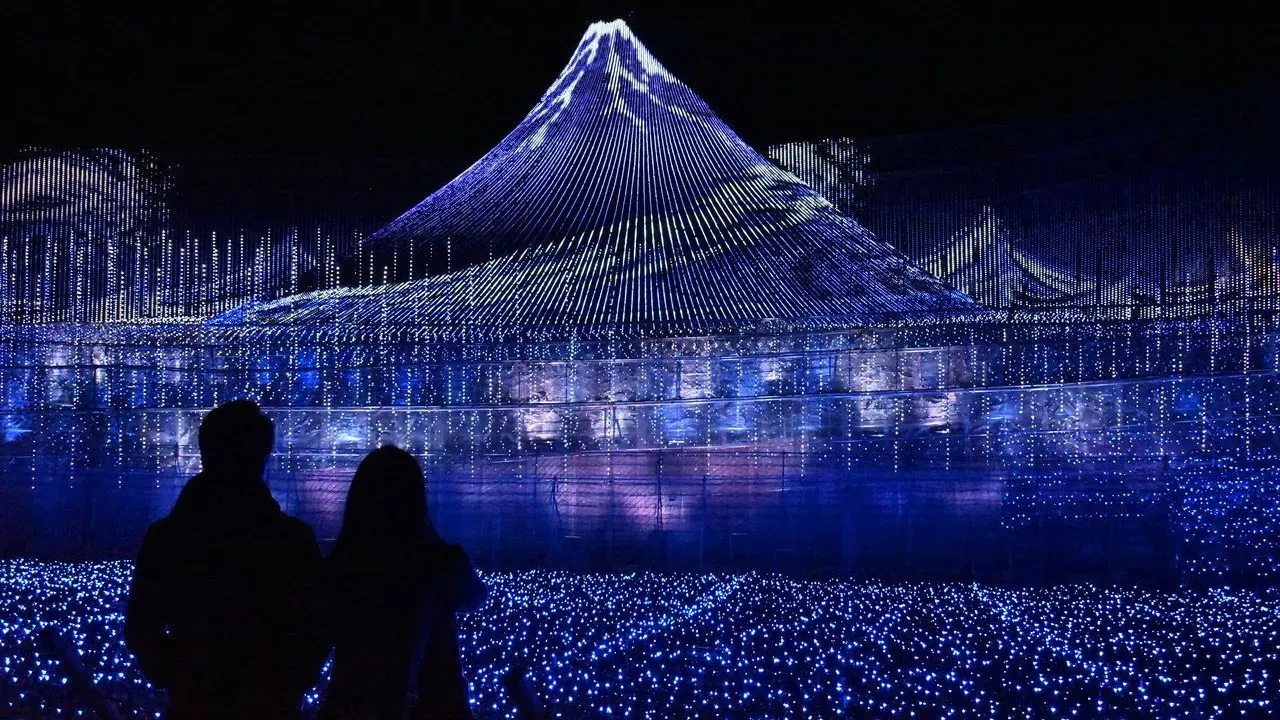

In Kuwana, Mie Prefecture, the gardens of Nabana no Sato spend most of the year in bloom. Tulips, roses, and hydrangeas give way to a different kind of spectacle once the days shorten. According to ([1]), the park’s winter illumination takes over after dark, with LED installations, colorful gardens, and light tunnels filling the grounds. The park sits within reach of Nagoya, Kyoto, and Osaka, which makes it a practical stop for travelers exploring central Japan.
Flowers by Day, Light After Dusk
Few places in Japan offer two distinct seasons within a single visit. The park’s flower fields are at their most colorful during the daytime, while the illumination requires darkness to work its effect. Visitors who want both may find spring the most rewarding time to come, since the lights start later in the evening as the days grow longer. In the darker winter months, the displays generally switch on around 5:00 PM.
The 2026 to 2027 illumination season runs from October 17, 2026, through May 31, 2027, and the park is closed on January 6 and 7, 2027, ([2]). Regular hours run from 10:00 AM to 9:00 PM, with some weekends and holidays extending to 10:00 PM. Last admission is 30 minutes before closing. Schedules can shift from one date to the next, so checking the official calendar before setting out is a sensible step.
Following the Light Through the Park
The illumination is laid out as a sequence of scenes, and the route rewards a slow walk. Near the entrance, a space filled with blue LEDs is known as the Cloud Sea of Light. A little further on, Kagami-ike pond mirrors the maples lining its banks, and the lights that flash across the trees double the effect on the water. The park’s best-known feature is a light tunnel about 200 meters long. Walking straight to its middle, rather than joining the crowd at the entrance, lets visitors experience it with more space. Rain can add to the scene, since wet ground reflects the illumination.
Several other areas complete the circuit:
- Hikari-no-taiga, at the center of the park, where a river of lights runs beside the water.
- A second tunnel, about 100 meters long, with flower-shaped bulbs whose colors change from year to year.
- The Panorama of Illuminations, a show that changes theme annually and can be viewed up close or from a nearby building with seating.
The 2026 to 2027 Panorama is built around Wild Paradise, a theme that draws on prehistoric dinosaurs, wildlife-filled savannas, waterfalls, and jacaranda flowers. For a wider view, the Island Fuji observation deck lifts visitors 45 meters above the park and turns a full 360 degrees, so every seat gets a view of the displays. Payment for the deck is in cash only, and park admission vouchers cannot be used for it.
A Calendar of Blooms
The flower side of the park follows its own rhythm, with different displays arriving through the year. The greenhouse known as the Flower Garden in the Andes and Begonia Garden is open all year, and its admission is included in the regular paid entrance ticket. Its final section holds Mikaeri-no-ike, a pond where flowers hang above the water.
| Period | What Blooms |
|---|---|
| Early February to late March | Plum trees, weeping plum, and early-blooming Kawazu cherry |
| Late March to mid-May | Tulips with over 200 varieties, daffodils, and blue nemophila |
| Early May to late July | Roses with more than 800 kinds, plus hydrangea, cosmos, and iris |
| September to November | Cosmos and dahlias |
Mid-April is a particularly blue moment, when the nemophila, sometimes called baby blue eyes, opens across the beds. Rose season also brings a local favorite, the rose soft serve, which is worth trying between garden walks.
Getting There and Planning the Visit
The simplest route from Nagoya is a direct bus from the Meitetsu Bus Center at Nagoya Station, which takes roughly 30 to 35 minutes. Travelers can also take a Kintetsu train to Kintetsu Nagashima Station and transfer to a short shuttle bus. From Kyoto or Osaka, the Kintetsu Railway toward Nagoya is the usual approach. Visitors arriving by car will find free parking on site.
Admission varies by date. Advance tickets bought at convenience stores cost about 2,500 to 3,000 yen for most of the season, with same-day gate purchases running about 200 yen higher. December 23 to 25 requires a special date-specific ticket, which costs 5,500 yen and includes a voucher, and it is best to book early for that period ([3]). Visitors traveling across several cities may find a Kintetsu Rail Pass useful, while those visiting only from Nagoya may do better with standard train and bus tickets. Choosing a weekday also tends to ease the weekend crowds that gather around the tunnel.
The park’s scale is part of its appeal. With more than eight million LEDs ([4]), the winter displays are among the country’s most ambitious. Yet the place feels most rewarding when visitors move slowly, watch the reflections on the pond, and leave room for others on the path. For travelers who plan ahead, a spring visit offers blooms by daylight and a glowing garden once the sun goes down.
AI Disclaimer: This article was created with the assistance of AI tools and reviewed by a human editor.