
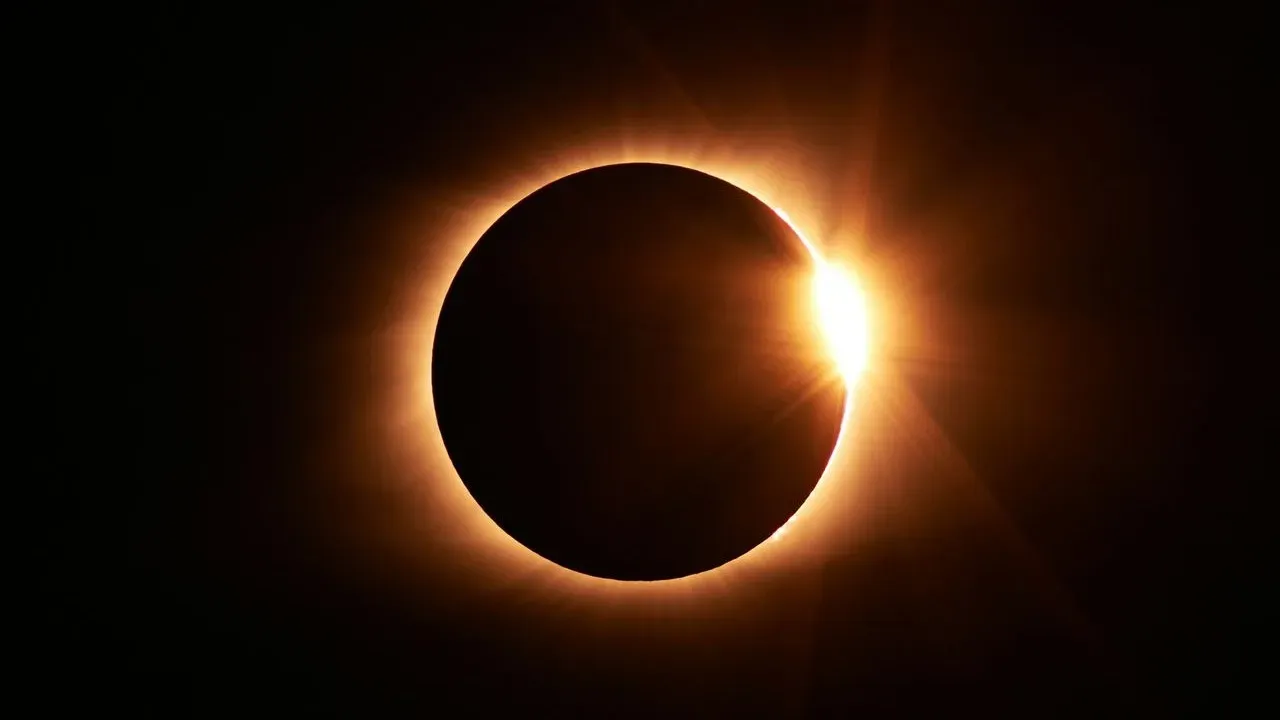

On August 12, the moon will pass directly between the sun and Earth, casting its shadow across parts of the northern Atlantic and into Europe. For mainland Spain, this marks the first total solar eclipse in more than a century. The event also reaches Greenland and Iceland, offering a rare alignment visible under clear skies near sunset.
The Path of Totality
The moon’s shadow begins near the North Pole and moves southward. Totality, the period of complete darkness, lasts up to two minutes and eighteen seconds at its longest point off Iceland’s west coast. The shadow then crosses a small section of Portugal before reaching Spain, where it shortens to roughly one minute. The path concludes in the Mediterranean after traveling more than five thousand miles, most of it over open ocean.
Viewers farther from the centerline will still experience a partial eclipse. Coverage reaches 94 percent in Dublin and 83 percent in Oslo. In North America, Montreal sees about 18 percent, while New York experiences roughly 9 percent. Special eclipse glasses remain essential wherever any portion of the sun remains visible.
Additional Celestial Highlights
The same day features a rare planetary alignment before dawn, with six planets forming an arc across the sky. After nightfall, the Perseid meteor shower reaches its peak under a new moon. Brighter meteors may appear during or near totality, while planets and stars become visible in the darkened sky.
These combined phenomena create an extended period of astronomical interest. Observers in Greenland fjords or along the Spanish coast can plan for both the daytime darkness and the evening meteor activity without needing to travel between separate events.
Scientific Observations Underway
Research teams are preparing multiple projects to study atmospheric and solar changes during the brief window of totality. The European Space Agency will broadcast live from Spain’s Astrophysical Observatory of Javalambre and host a public event in León. NASA-supported efforts include more than sixty high-altitude balloons launched from Spain and Iceland to measure temperature drops and other effects.
A NASA research aircraft will fly along the path at 460 miles per hour, extending the observation time for its instruments to nearly three minutes. Four cameras aboard will capture the sun’s corona in multiple wavelengths. These coordinated efforts build on similar campaigns conducted during the 2024 North American eclipse, though the current path offers new geographic coverage.
Looking Ahead to Future Alignments
Spain will host an even longer total eclipse on August 2, 2027, with up to six minutes and twenty-three seconds of totality extending across North Africa and the Middle East. A ring-of-fire eclipse follows on January 26, 2028. Together these events form an uncommon sequence for the region.
The last total solar eclipse visible from mainland Spain occurred in 1912. The upcoming August alignment therefore represents a distinct opportunity for both scientific study and public observation in locations that have waited generations for such an event.
AI Disclaimer: This article was created with the assistance of AI tools and reviewed by a human editor.