
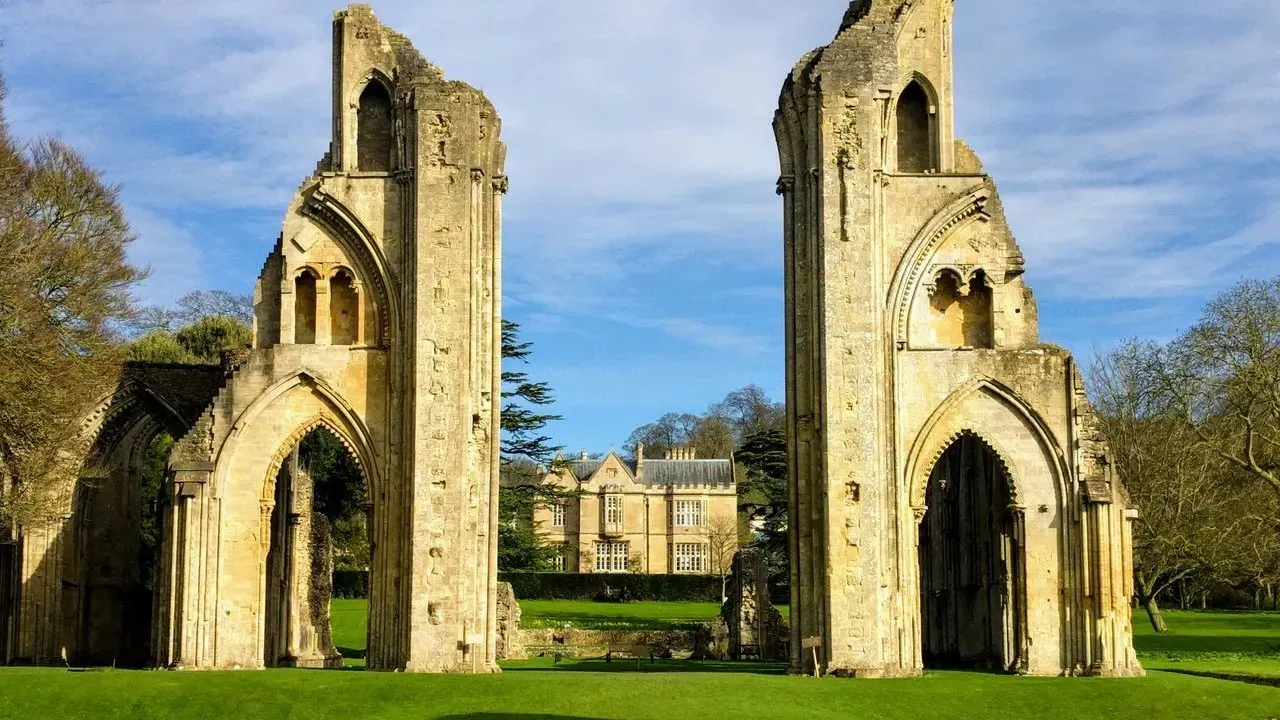

Somerset, England, holds one of the country’s most evocative monastic sites in Glastonbury Abbey. Its weathered stone walls and open grounds invite visitors to consider centuries of religious life alongside enduring stories of King Arthur and Guinevere. A visit guided by someone deeply familiar with the place brings these layers into clearer focus without turning legend into fact.
Centuries of Monastic Life
The abbey began as a modest religious community and grew into one of the wealthiest and most influential Benedictine houses in medieval England. Successive building campaigns left behind a complex of chapels, cloisters, and domestic ranges whose surviving fragments still convey the scale of that enterprise. Visitors today walk among the remains of the great church and the abbot’s kitchen, structures that once anchored daily rhythms of prayer, study, and hospitality.
Local knowledge adds texture to these stones. A guide familiar with the site can point out subtle changes in masonry that mark different building phases and explain how the community adapted to royal patronage and shifting political fortunes. Such details turn a walk through the ruins into a conversation with the past rather than a simple stroll.
The Arthurian Connection
By the late twelfth century, Glastonbury had become linked in popular imagination with the burial of King Arthur and Queen Guinevere. Monks announced the discovery of their graves in 1191, an event that drew pilgrims and strengthened the abbey’s prestige. Historians treat the claim as part of the abbey’s efforts to secure its standing rather than verified history, yet the association has never faded.
The legend continues to shape how many people experience the abbey today. Standing in the nave or beside the site once identified as the royal tomb, visitors sense how myth and documented record have long intertwined at this location. A local expert can separate the threads, showing where verifiable records end and storytelling begins, while still honoring the power of the tale.
Walking the Grounds with Insight
Planning a visit with a knowledgeable local changes the pace and depth of the experience. Instead of moving quickly from one labeled point to the next, travelers linger where the guide highlights a carved capital or the alignment of windows that once framed the high altar. These pauses allow the scale of the original buildings to register more fully.
The surrounding landscape adds another dimension. The abbey sits within a town whose streets and hills carry their own stories of pilgrimage and seasonal gatherings. A guide can connect the monastic precinct to the wider setting, noting how the community once drew resources from the surrounding levels and how modern conservation work protects both the ruins and the habitat they now shelter.
Respectful Exploration Today
Responsible visitors approach the abbey as a living heritage site rather than a backdrop for photographs alone. Staying on marked paths, supporting the conservation efforts through admission fees, and learning the difference between documented history and later embellishment all contribute to its long-term care. Local guides often model this approach by sharing practical ways to reduce impact while deepening appreciation.
The abbey rewards those who arrive with curiosity and patience. Its stones continue to speak of devotion, ambition, and the human need to anchor stories in place. A well-guided visit leaves travelers with a clearer sense of how one English ruin still holds space for both verifiable history and the legends that have grown around it.
AI Disclaimer: This article was created with the assistance of AI tools and reviewed by a human editor.