
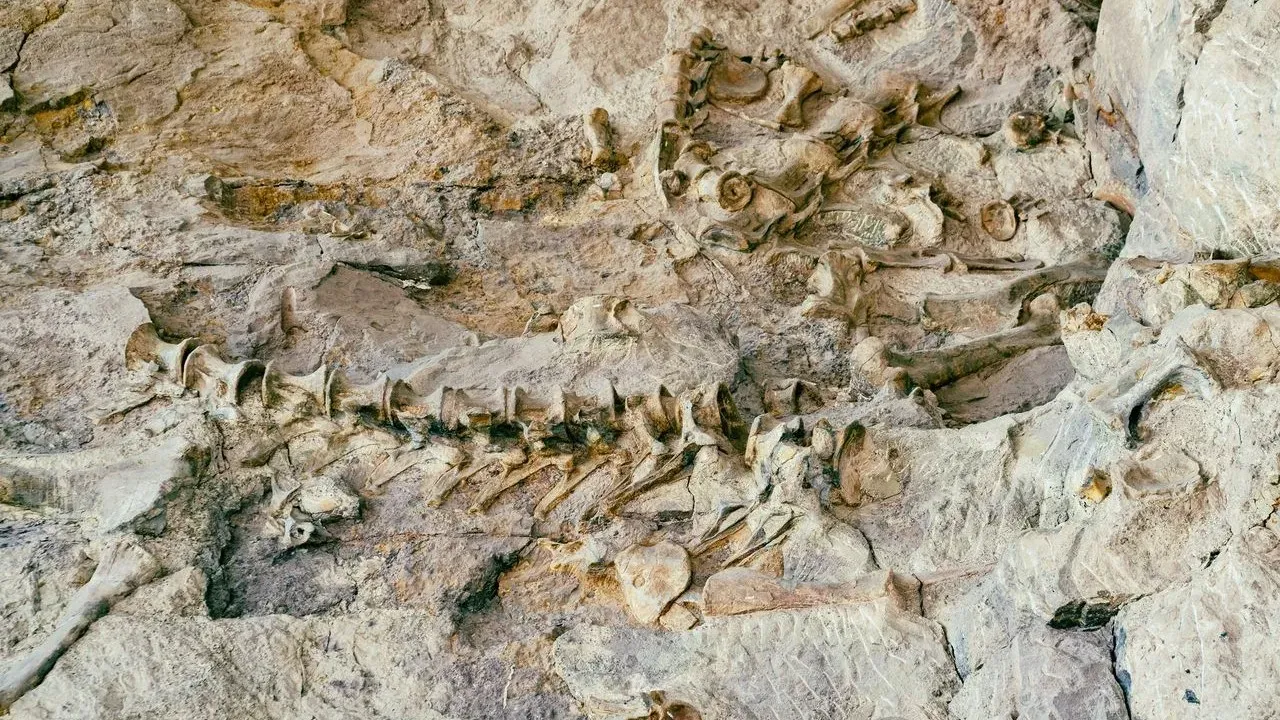

London’s Natural History Museum recently confirmed that a modest backbone fragment collected in 1985 belongs to the first dinosaur ever documented on the Antarctic continent. The specimen had rested in a geological collection drawer for nearly forty years before its true identity came to light. That quiet rediscovery now adds a vivid chapter to the story of a place many travelers approach with a sense of deep-time wonder.
The Quiet Moment of Recognition
Mark Evans, who manages geological collections for the British Antarctic Survey, noticed the vertebra while reviewing material from an earlier expedition. Its proportions and texture stood out against the expected marine reptile remains. Further study placed the bone within the Titanosaur group, long-necked plant-eating sauropods whose largest members rank among the heaviest land animals known.
The fragment itself is modest, roughly ten centimeters across. Researchers estimate the living animal measured six to seven meters long, consistent with a juvenile or smaller adult. At the time it lived, around 82 million years ago, the continent supported temperate forests rather than the ice sheets that dominate today.
Antarctica’s Changing Landscape Through Deep Time
During the Late Cretaceous, Antarctica formed part of the supercontinent Gondwana. The new identification shows that titanosaurs moved between what are now South America and Australia by way of this southern landmass. The presence of such a large herbivore also implies abundant vegetation, a detail that helps reconstruct the continent’s ancient ecosystems.
Today’s extensive ice cover limits fossil exposure, yet retreating glaciers are gradually revealing more bedrock. Paleontologists note that continued careful fieldwork may uncover additional evidence of this earlier biodiversity. For travelers drawn to Antarctica’s austere beauty, these findings underscore how much of the continent’s natural history remains to be understood.
Collections That Keep Stories Alive
The vertebra’s long stay in storage illustrates the lasting value of scientific archives. Specimens gathered decades ago can yield fresh insights when examined with updated methods or perspectives. In this case, a single element has clarified dinosaur distribution across the southern continents and reinforced the idea that these animals once inhabited every major landmass.
Experts unaffiliated with the study have described the find as a reminder that museum holdings continue to reward patient stewardship. The bone’s significance lies less in its size than in the geographic and temporal context it supplies, connecting distant regions through the movements of ancient life.
Traveling With Awareness of a Living Continent
Expedition voyages to the Antarctic Peninsula and surrounding waters already invite passengers to consider the region’s layered past. Guides often share current research on changing ice, wildlife adaptations, and geological records. Learning about this newly recognized dinosaur adds one more dimension to those conversations without requiring specialized knowledge.
Responsible operators emphasize minimal impact, support for scientific permitting, and respect for the continent’s protected status. Visitors who arrive curious about both present ecosystems and deep-time evidence tend to leave with a stronger sense of stewardship. The fossil’s story fits naturally into that broader narrative of discovery and care.
Looking Ahead
As more material emerges from retreating ice, the scientific community expects further surprises from Antarctica’s fossil record. Each verified specimen refines our picture of how life adapted across shifting continents. For those planning a journey south, the knowledge that dinosaurs once browsed forests where only ice now meets the sea offers a quiet, lasting sense of scale.
The vertebra itself remains in secure storage, available for future study. Its journey from field notebook to published paper demonstrates how patient observation can still illuminate one of Earth’s most remote frontiers.
AI Disclaimer: This article was created with the assistance of AI tools and reviewed by a human editor.