
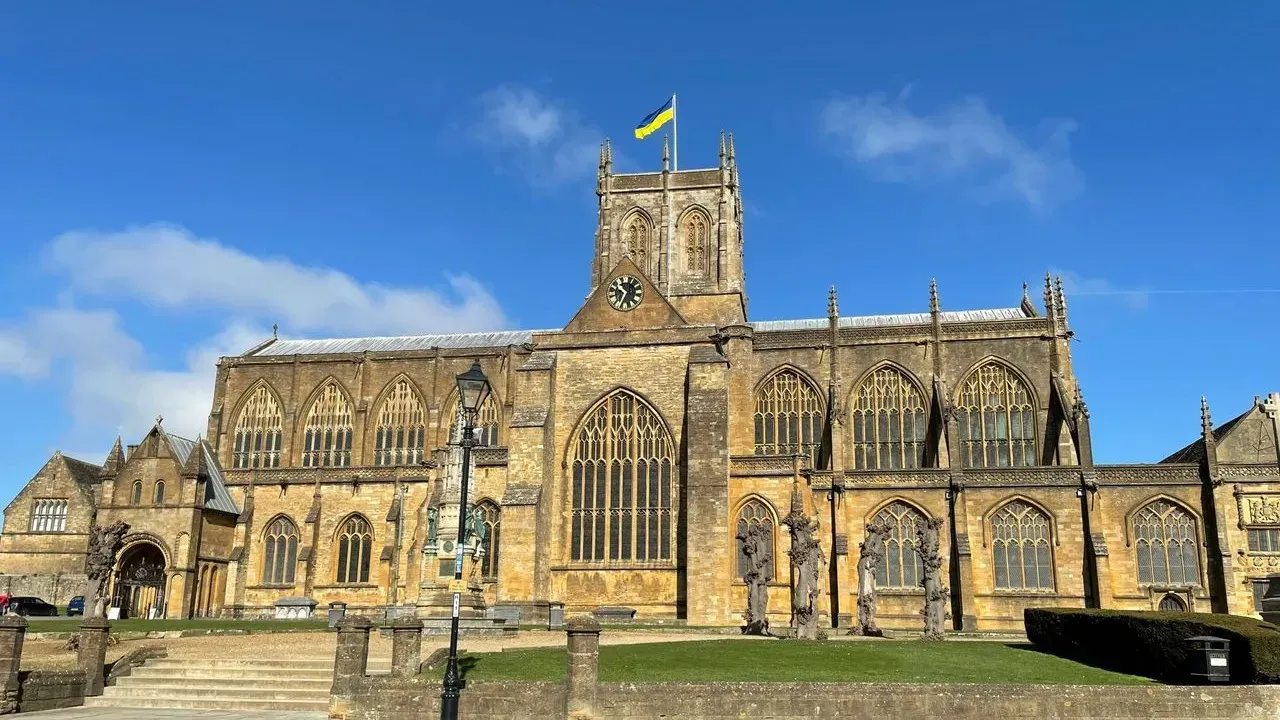

In the Dorset market town of Sherborne, the Abbey Church of St Mary the Virgin rises as a testament to more than 1,300 years of continuous worship and architectural refinement. What began as a Saxon cathedral in the seventh century later served as a Benedictine monastery, its stones bearing witness to centuries of English religious and civic life. Today the building remains an active parish church, its presence shaping the rhythm of the surrounding historic streets.
Foundations Laid in Saxon England
The abbey’s story opens in the early medieval period when Sherborne became the seat of a bishopric. Monks and scholars established a community here that would endure through invasions, reforms, and the shifting fortunes of the English church. The original Saxon structure provided the core around which later generations built, preserving a sense of continuity rare among surviving ecclesiastical sites.
Archaeological traces and documentary records show how the site adapted after the Norman Conquest. The Benedictine order took formal possession, expanding the complex while maintaining its role as a center of learning and prayer. These early layers remain visible in the fabric of the building, offering visitors a direct connection to England’s pre-Conquest past.
Mastery of Medieval Stonework
Over successive centuries the abbey acquired the soaring proportions and intricate detailing that define its character. Gothic elements introduced in the later Middle Ages include remarkable fan vaulting that spreads across the nave like a stone canopy. The technique, demanding both engineering precision and artistic vision, creates an interior of exceptional lightness and grace.
Windows, arcades, and carved details reflect the evolving tastes of masons who worked across generations. Each addition respected what came before, resulting in a harmonious whole rather than a patchwork of competing styles. The result is an interior that rewards slow exploration, with light shifting across surfaces throughout the day.
A Living Presence in Sherborne
Beyond its architectural significance, the abbey continues to serve the community that surrounds it. Regular services, concerts, and quiet moments of reflection keep the space alive in ways that purely historic monuments cannot match. The market town itself, with its Georgian facades and independent shops, provides a fitting setting that feels both preserved and lived-in.
Local residents and returning visitors often speak of the abbey’s role as a gathering point during festivals and commemorations. Its churchyard and cloister remnants offer places for contemplation amid the bustle of daily life in Dorset. This integration of sacred space and civic identity distinguishes Sherborne from many larger cathedral cities.
Approaching a Visit with Care
Travelers who plan time at the abbey benefit from arriving with an awareness of its ongoing function as a place of worship. Respectful conduct, modest dress, and attention to posted guidelines help maintain the atmosphere that draws people seeking both beauty and stillness. Guided tours, when available, illuminate details that might otherwise pass unnoticed.
Combining a visit with a walk through Sherborne’s streets allows a fuller sense of how the abbey has shaped the town’s development. Nearby historic buildings and green spaces provide additional context without requiring long journeys. Such measured exploration aligns with the abbey’s own patient evolution across the centuries.
The abbey stands as an invitation to consider how places of worship can endure while remaining relevant. Its stones hold stories of faith, craftsmanship, and community that continue to unfold for those willing to look closely. In Sherborne, that quiet continuity offers its own form of inspiration.
AI Disclaimer: This article was created with the assistance of AI tools and reviewed by a human editor.