
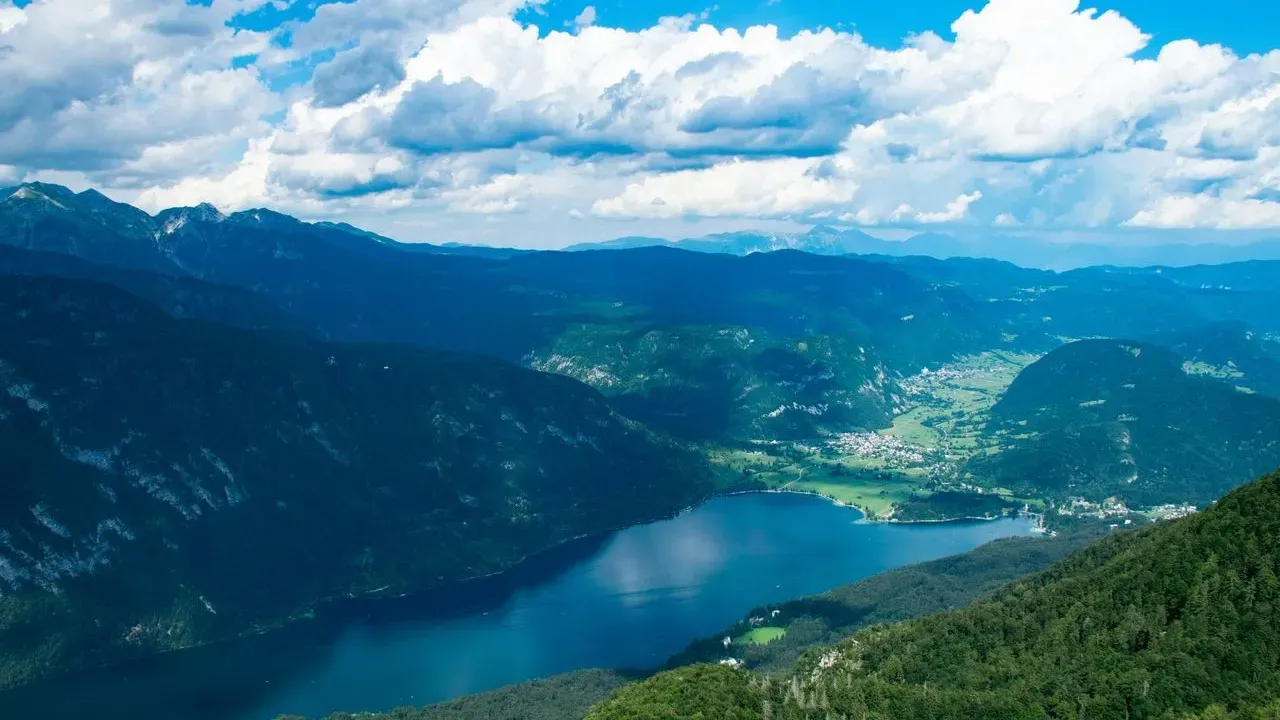

Lake Bohinj rests deep within Triglav National Park, where the mountains press close to the water and the surface often lies mirror-calm. Visitors who arrive expecting bustle instead find a place that rewards unhurried movement. A paddleboard drifting in the middle of the lake can become a platform for quiet reflection, with only the occasional soft splash or distant bird call breaking the silence.
A Setting Shaped by Mountains
Slovenia’s largest permanent lake sits entirely inside the national park, its shoreline framed by forest and rock on three sides. The result is a contained alpine bowl that feels both intimate and expansive. Light changes quickly here, turning the water from deep blue to silver as clouds pass overhead.
Access from the more visited Lake Bled takes roughly thirty minutes by car or bus along a scenic route. The short distance makes it simple to experience both lakes on one trip without rushing between them. Many travelers choose to base near Bled and add a full day or two at Bohinj for its distinct atmosphere.
Time on the Water
Stand-up paddleboarding offers one of the most direct ways to meet the lake on its own terms. Rentals are available at several points around the shore, and some operators deliver boards to chosen launch spots, allowing paddlers to drift from one end toward the other. The minimum rental period is usually two hours, enough for a gentle crossing and time to pause.
Swimming is equally inviting along the south shore, where shallow shingle beaches slope gently into clear water. Early morning visits often mean fewer people and cooler, refreshing temperatures. An eleven-kilometer walking path circles the entire lake on mostly flat terrain, taking three to four hours at a relaxed pace and offering frequent chances to stop and wade in.
Nearby Natural Extensions
A short distance beyond the western end of the lake lies Savica Waterfall. The trail climbs about a mile through trees to a viewing platform, passing roughly 550 steps. The falls emerge from the mountainside in two streams that form an A-shape before dropping into a transparent green pool.
Farther up the slopes, the Vogel cable car rises quickly to an elevation of 1,535 meters. From the top, trails lead outward and the full basin of Lake Bohinj spreads below. In summer the area serves as a starting point for hikes rather than skiing, providing a different perspective on the same landscape.
Practical Notes for a Measured Visit
Parking requires payment at marked areas around the lake and at trailheads such as Savica. May through October brings the most reliable weather for water activities, though July visits have shown that even peak summer months need not feel crowded. Public transport and bike routes connect Bohinj with Bled, and some packages combine e-bike rental with return bus service.
Local eateries such as Restavracija Kramar near Stara Fužina serve fresh trout and seasonal salads with views across the water. A simple coffee stop before launching a paddleboard can set a calm tone for the day ahead. Allowing at least three days total for the two lakes gives space to move between them without pressure.
The real gift of Lake Bohinj lies in how readily it invites visitors to match its own unhurried rhythm.
That measured pace lingers after departure, turning ordinary days on the water into lasting memories of mountains, clear air, and the simple act of being present.
AI Disclaimer: This article was created with the assistance of AI tools and reviewed by a human editor.