
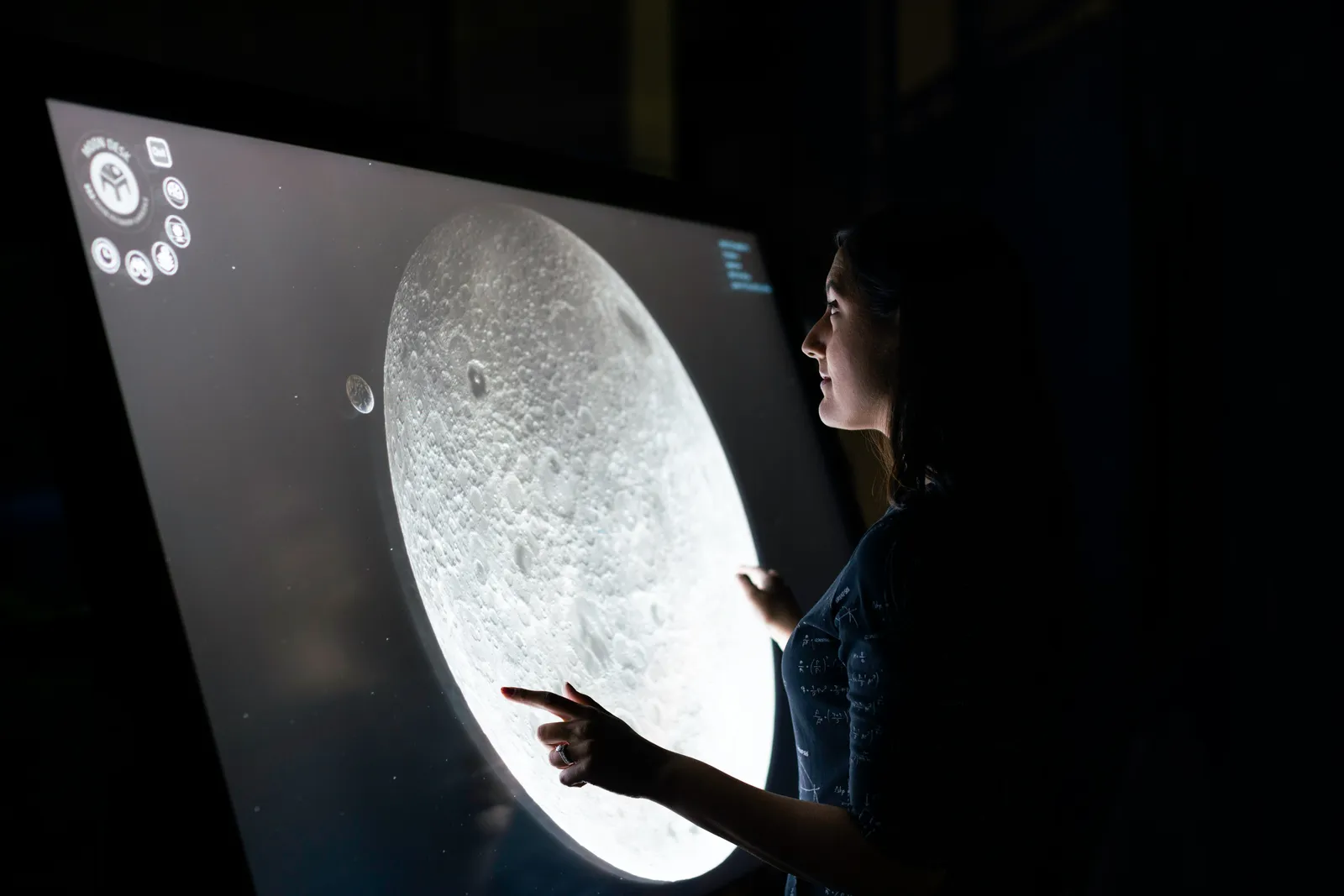

Washington DC – A new virtual reality installation now gives visitors the chance to move through the universe using data drawn directly from scientific observations. The 5,000-square-foot attraction in Penn Quarter marks the first project of its kind in the capital and stems from a partnership between the Smithsonian Astrophysical Observatory and events company Fever. Designers worked closely with astrophysicists to translate real measurements of stars, black holes, and nebulae into an interactive environment that emphasizes the immense distances involved.
Grounded in Verified Astronomical Data
The experience was constructed from actual scientific datasets rather than artistic approximations. Astrophysicists advised on the relative sizes, distances, and behaviors of celestial objects so that movements and scales remain consistent with established research. This approach distinguishes the installation from purely fictional simulations and allows participants to encounter phenomena as they are understood through telescopes and spacecraft observations.
Every element, from the texture of solar surfaces to the curvature near a black hole, reflects measurements collected by observatories. The result is an environment that feels both vast and precise, giving users a tangible sense of how small Earth is within the larger structure of the universe.
Key Destinations Within the Virtual Universe
Participants strap on headsets and navigate several distinct locations that highlight different aspects of cosmic scale. The sequence begins near the surface of the sun before shifting to regions where gravity becomes extreme. Later stops include iconic formations that astronomers have studied for decades.
- Standing on the sun’s surface amid intense heat and light
- Approaching the event horizon of a black hole
- Viewing the Pillars of Creation in the Eagle Nebula
Transitions between these sites are designed to convey the emptiness of space and the time required to travel between them. Many visitors report a momentary sense of disorientation followed by awe as the true proportions become apparent.
Why the Project Matters for Public Understanding
Science centers have long sought ways to communicate the size of the universe without relying on numbers alone. This installation uses physical movement and visual immersion to make those concepts immediate. By placing participants inside environments built from observatory data, the attraction turns abstract measurements into something people can experience directly.
The collaboration also signals a broader trend of cultural institutions working with technology partners to reach new audiences. Events company Fever handled the logistics and venue setup while the Smithsonian supplied the scientific foundation, creating a model that could be adapted for other topics in the future.
Visiting the Attraction
The Penn Quarter location is open to the public with sessions available through the dedicated Smithsonian Starstruck website. Tickets are sold in timed slots to manage capacity inside the 5,000-square-foot space. No prior knowledge of astronomy is required, though the experience rewards curiosity about how the universe actually works.
Organizers expect the attraction to draw both local residents and travelers already visiting Washington DC landmarks. Its central location makes it easy to combine with other downtown activities, adding a memorable, science-focused stop to many itineraries.
The project demonstrates how established institutions can use virtual reality to extend their reach while remaining faithful to the evidence gathered by researchers. For anyone who has looked up at the night sky and wondered about the distances involved, the installation offers a direct way to explore those questions in a controlled, data-driven setting.
AI Disclaimer: This article was created with the assistance of AI tools and reviewed by a human editor.