

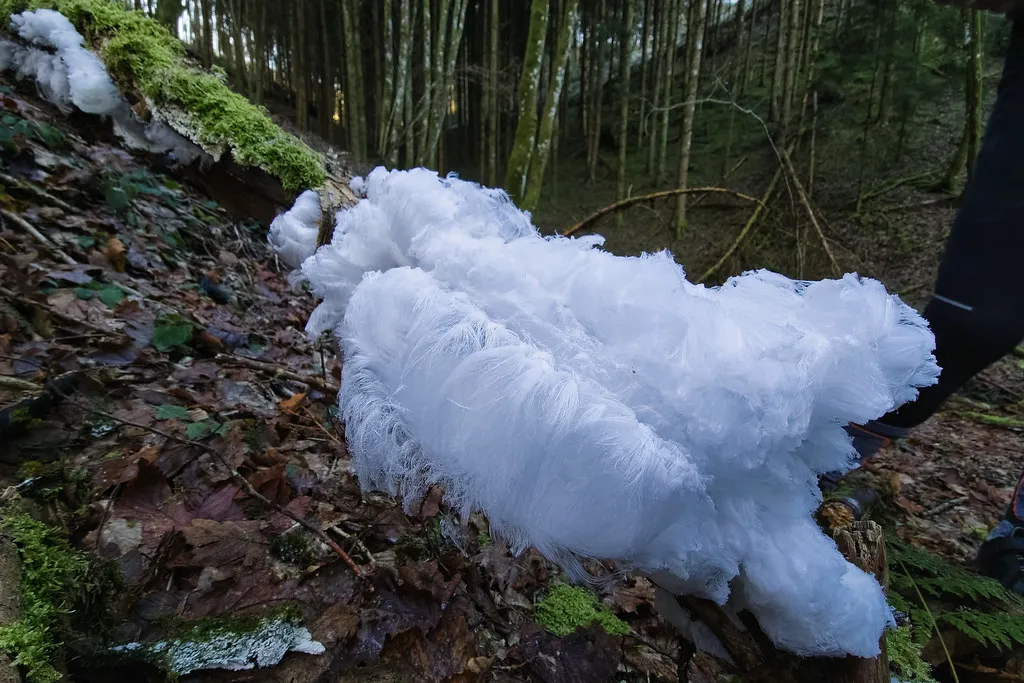
On a cold, damp winter morning, you might walk through a forest and stop suddenly at something that looks impossible: delicate white filaments, silky and fine, sprouting from a fallen log as if the wood itself had grown hair overnight. It’s not frost. It’s not mold. It’s something stranger and more specific than either of those things.
This phenomenon is called hair ice, and it has puzzled scientists, naturalists, and curious forest walkers for well over a century. The fact that it took researchers so long to explain it is part of what makes it genuinely fascinating. The science behind it turns out to involve a fungus, a process of ice physics, and a natural antifreeze that keeps each strand impossibly thin.
What Hair Ice Actually Looks Like
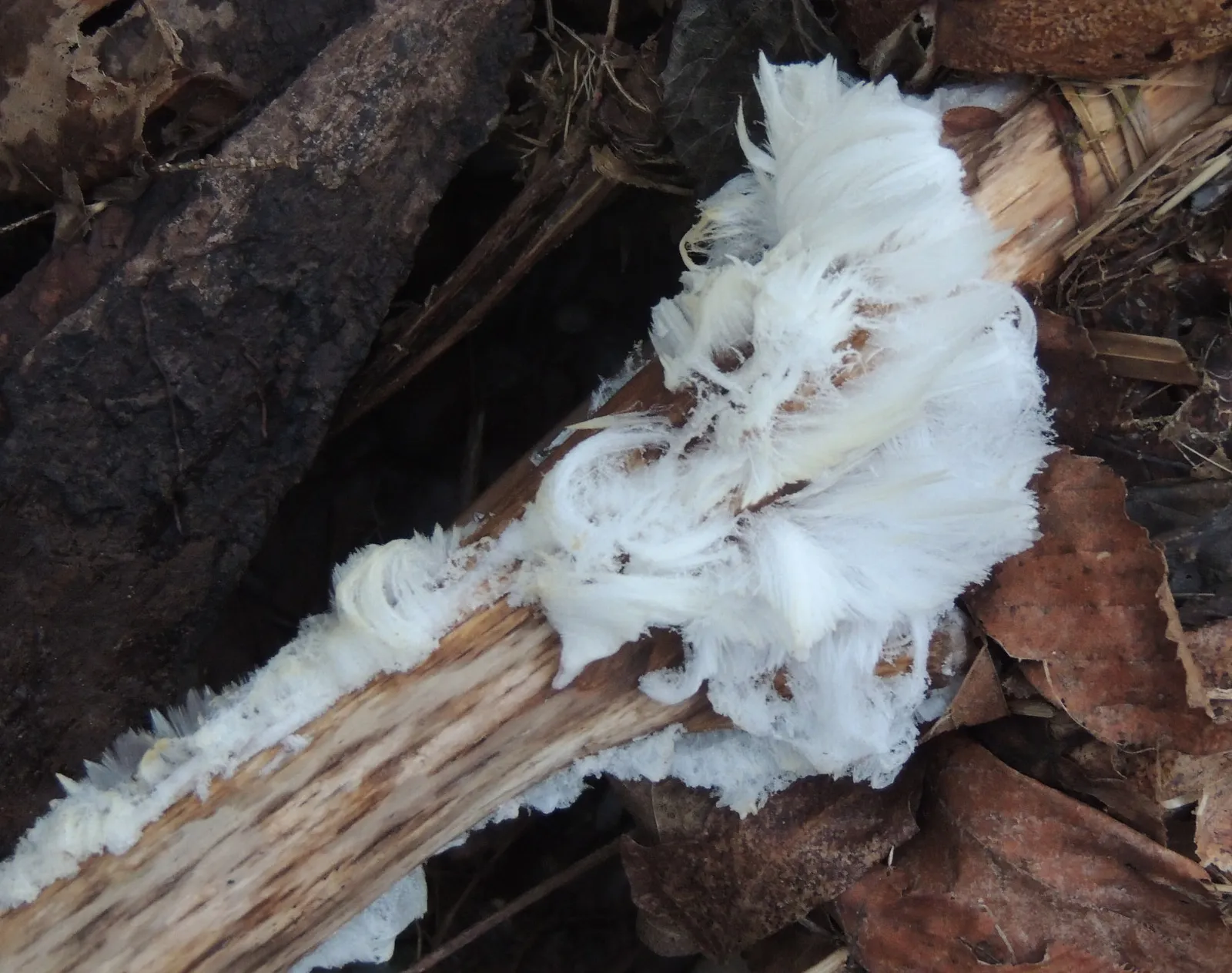
Hair ice, also known as ice wool or frost beard, is a type of ice that forms on dead wood and takes the shape of fine, silky hair. These hair-like, flexible structures can reach up to ten centimeters in length without any ramifications. Up close, each strand is so thin and white that the formation can resemble a miniature wig, a cotton puff, or even a delicate sea creature washed up on the wrong shore. The visual effect is genuinely startling.
A keen eye might spot delicate crystals extending from wood in filaments about 0.01 millimeters thick, roughly the diameter of a human hair. Despite being made of ice, the strands have a softness and uniformity to them that seems almost biological. Touch them, though, and they melt instantly.
Where and When It Appears
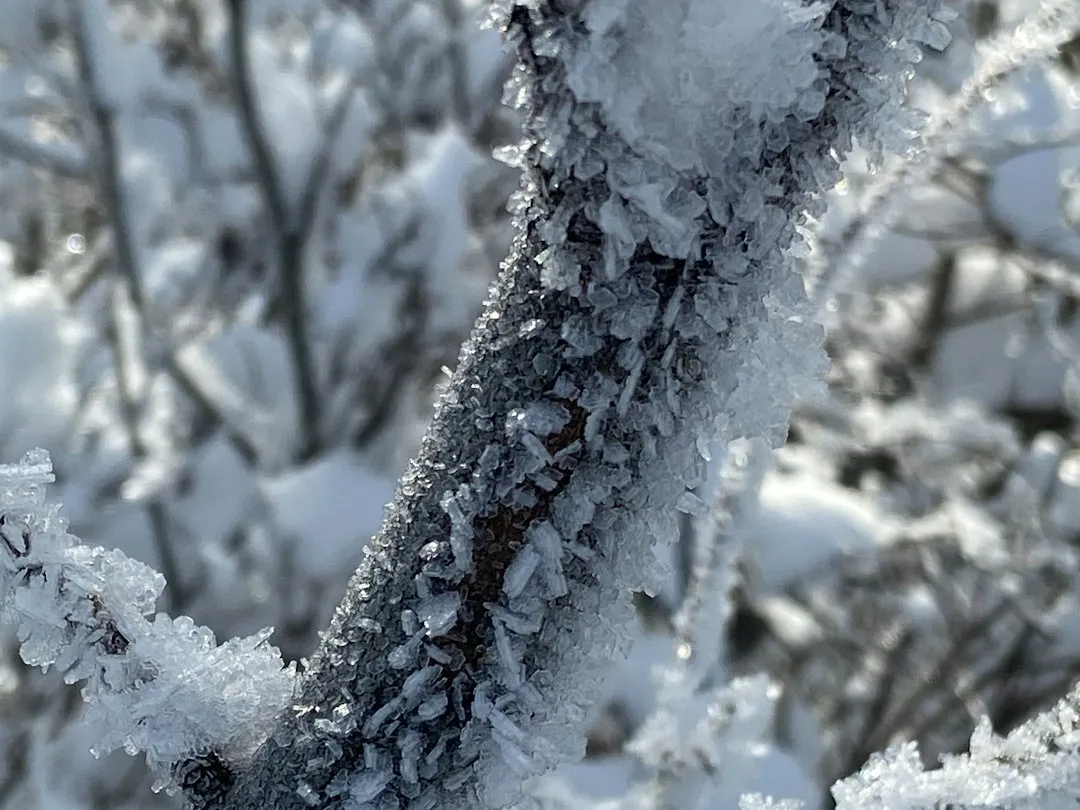
Hair ice grows on the rotten branches of certain trees when the weather conditions are just right, usually during humid winter nights when the air temperature drops slightly below 0°C. The timing is precise. Too cold and the formation doesn’t develop the same way. Too warm and nothing freezes at all.
Hair ice is typically found in deciduous forests between 45°N and 55°N latitude. The best time to spot it is during early morning walks in winter, particularly after nights when temperatures have dropped just below freezing. There are many reports on the observation of hair ice, mainly at latitudes between 45 and 55 degrees North, in Canada, France, Germany, India, Ireland, Netherlands, Scotland, Slovenia, Sweden, Switzerland, the USA, and Wales.
A Mystery More Than a Century Old
Although hair ice has been described and theorized about in the scientific literature for over 100 years, the research into the conditions and mechanisms under which it occurs has only been more fully described by scientists in the last decade or so. That gap between first observation and scientific explanation is remarkable, considering how many other natural phenomena were decoded in the same period.
The meteorologist and discoverer of continental drift, Alfred Wegener, described hair ice on wet dead wood in 1918, assuming some specific fungi as the catalyst. In 1918, he noticed a whitish cobwebby coating on the surface of hair-ice-bearing wood, which his assistant identified as fungus mycelium, the mass of thin threads from where mushrooms grow. He suggested there was a relation between the ice and the fungus in the wood. He was right, but proving it took another century.
The Fungus Behind It All
A team of scientists in Germany and Switzerland identified the missing ingredient that gives hair ice its peculiar shape: the fungus Exidiopsis effusa. Scientists have found it in every single sample of hair ice they’ve examined. The consistency of that finding is what made it so compelling as evidence.
Although many trees can make hair ice across ten species from five families of broadleaf plants, only one fungus appeared in every hair ice sample: Exidiopsis effusa. This species belongs to the kingdom Fungi, division Basidiomycota, and is the type species of the genus Exidiopsis. It’s a quiet organism living in dead wood, going largely unnoticed until a cold, humid night gives it something spectacular to do.
How the Ice Actually Forms
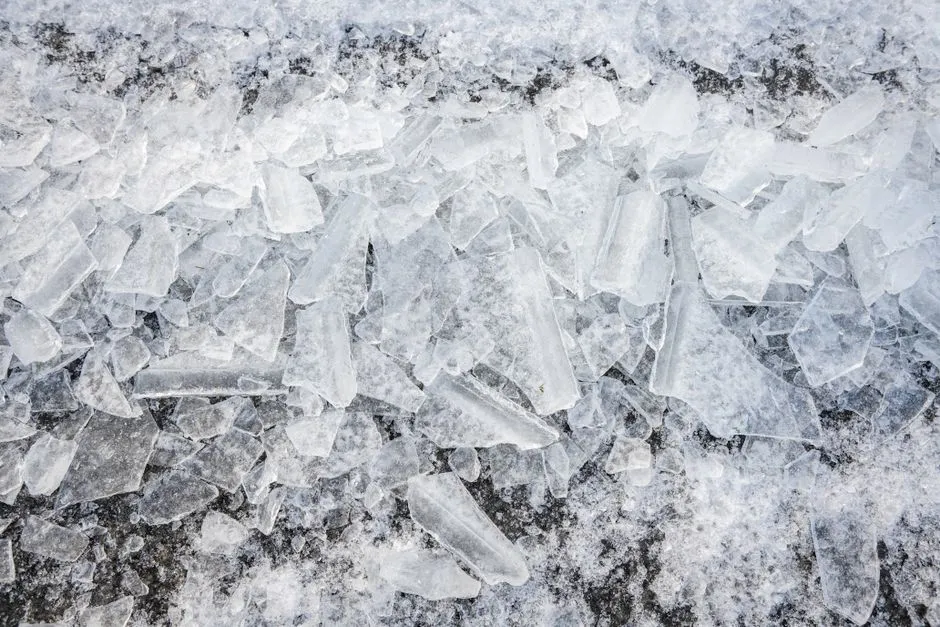
Under the right temperature and humidity conditions, ice forms on a branch surface while water stays liquid inside the wood’s pores. The temperature difference between the two states of water creates a suction that draws liquid water to the freezing front, gradually extending the reach of the growing hair. This process is called ice segregation, and it’s the physical engine driving the whole formation.
The hairs appear to root at the mouth of wood rays, never on the bark, and their thickness is similar to the diameter of the wood ray channels. The fungus weaves through wood vessels and sends tiny threads deep into the wood rays, growing along the wood and penetrating deeper into the tissue through those channels. The wood’s own anatomy essentially acts as a mold for each strand.
What Happens Without the Fungus
Lead researcher Diana Hofmann of the Institute of Bio- and Geosciences in Jülich, Germany, proved that the fungus was essential for the formation of hair ice. She did that by applying a fungicide to wood samples that had sprouted hair ice previously and comparing them to a control where she did nothing. When she recooled both samples, the fungicide-treated one did not grow hair ice. The other did.
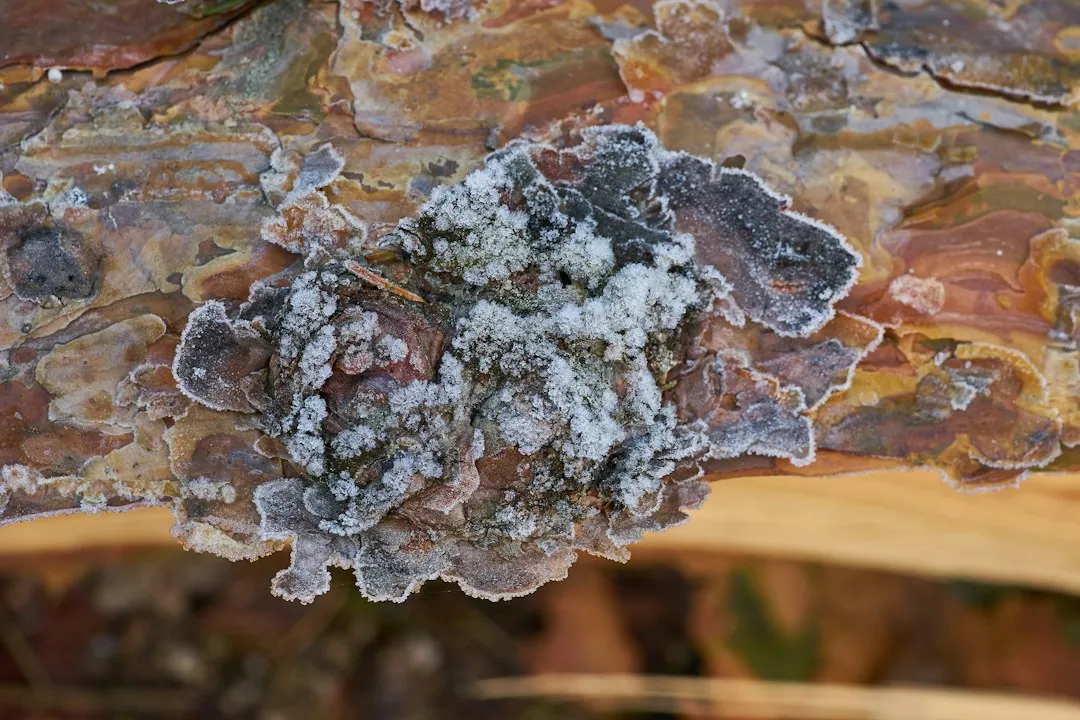
Killing Exidiopsis effusa with hot water also prevented new hair ice from developing when favorable conditions were restored. In the absence of the fungus, ice formed only a simple crust on the wood. That simple crust is what you’d expect from physics alone. The fungus is what turns physics into art.
The Role of Lignin, Tannin, and Natural Antifreeze
When hair ice was melted and its chemical makeup studied via mass spectrometry, scientists found that the organic substances within were lignins and tannins, two major components of wood. Lignin and tannin could be detected as the main hair-ice substance classes, supposed to act as freezing catalyst as well as recrystallization inhibitor. That last function is critical: it keeps each strand from merging into a coarser clump.
The fungus shapes the ice into fine hairs through an uncertain mechanism and likely stabilizes it by providing a recrystallization inhibitor similar to antifreeze proteins. Today, scientists continue investigating the precise mechanism behind how Exidiopsis effusa shapes these remarkable ice formations. Current research focuses on identifying the specific recrystallization inhibitor produced by the fungus. Scientists are particularly curious about decomposed lignin’s role since it appears prominently in chemical studies.
The Same Log Can Do It Again and Again
A piece of wood that produces hair ice once may continue to produce it over several years. These unique spots often produce hair ice repeatedly over several years when conditions are right. The phenomenon typically appears in the same place because the Exidiopsis effusa fungus remains active in the wood. If you find a good spot one winter, mark it mentally. The chances are good it will perform again.
Both fungicide-treated and heat-treated wood slowly regained the ability to produce hair ice over time, probably because the fungus recovered from its toxic exposures or some spores survived and later germinated. The fungus is resilient. It doesn’t give up its quiet, cold-season work easily.
Hair Ice vs. Needle Ice: A Common Confusion
Often mistaken for hair ice, needle ice is a related ice type that grows from soil instead of wood, has slightly stiffer needles, and forms columns. The two look similar at a glance, especially in a snowy forest where context is hard to read quickly. The key distinction is the substrate: wood for hair ice, soil for needle ice.
Hair ice, unlike frost needles, arises from the base. Its strands grow outward from the surface of the log in a radial pattern, creating that distinctive full, rounded silhouette. Needle ice, by contrast, tends to look more columnar and pushes upward in straighter lines from the ground.
A Published Research Milestone and What Remains Open
Mätzler, a physicist, joined forces with a chemist, Diana Hofmann, and a biologist, Gisela Preuß, in Germany. Inspired by earlier work and by photographs of hair ice sent in from various countries, the team performed a set of experiments to figure out just what conditions are needed to grow this type of ice and what its properties are. In the process, they confirmed a 100-year-old theory for the origin of hair ice.
The mycelium of Exidiopsis effusa appears to provide the supporting structure for the hairs of ice, which have a diameter of around only 0.02 mm, and Exidiopsis effusa’s fruiting body typically appears macroscopically weeks later on the wood surface as a thin, white rot coating. Today, scientists continue investigating the precise mechanism behind how the fungus shapes these remarkable ice formations, with current research focusing on identifying the specific recrystallization inhibitor it produces. The full biochemical story is still being written.
Why It Disappears So Quickly
Hair ice grows mostly during the night and melts again when the sun rises. It’s invisible in the snow and inconspicuous in hoarfrost. Its entire existence is tied to a narrow temperature window, and the moment conditions shift even slightly, the formation collapses back to water. That brevity is part of what makes spotting it feel like a small privilege.
While hair ice can maintain its shape for hours or sometimes even days, it typically disappears as soon as the sun’s warmth touches it. Persistence is possible under unusually stable, cold, and shaded conditions, but those are the exception. Most encounters with hair ice are measured in minutes after dawn, which is exactly why early walkers find it and afternoon hikers never do.
A Quiet Wonder Worth Seeking Out
Hair ice sits at one of those interesting intersections where biology, physics, and chemistry all converge to produce something that looks purely magical. A fungus digesting dead wood. Water moving through pores under suction. Organic molecules acting as natural antifreeze. None of those things are rare in themselves, but the combination, under just the right conditions, creates something that stops people in their tracks.
Dead wood from broadleaf trees like beech, oak, and maple provides the perfect substrate for the fungus to thrive. If you walk in temperate broadleaf forests during winter, particularly in the hour after a cold, humid night, you are within range of finding it. The only tools required are early rising and a willingness to look closely at the ground. Some of the most precise and elegant things in nature don’t announce themselves. They wait for the right morning, and the right pair of eyes.
AI Disclaimer: This article was created with the assistance of AI tools and reviewed by a human editor.