
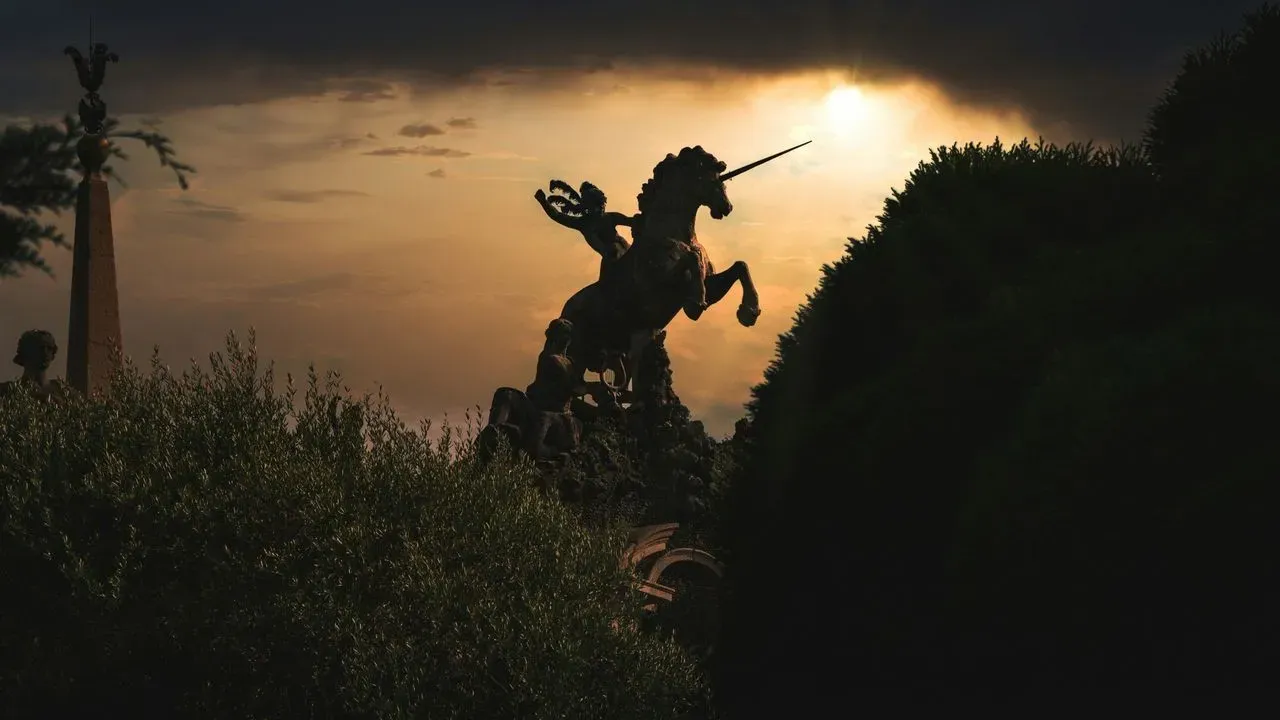

Washington, D.C. – Tucked along a quiet residential street in Northwest Washington lies Unicorn Lane, a short stretch of pavement that feels worlds away from the marble monuments and bustling avenues most visitors know. Here, two modest unicorn statues stand as the District’s only examples of their kind, their presence a quiet reminder that even the most ordinary corners can hold layers of unexpected history. The statues have drawn the attention of locals and curious travelers alike for the surprising figures connected to their story.
A Street Named for Myth
Unicorn Lane sits near the edge of Rock Creek Park, where the city’s dense greenery meets a neighborhood of stately homes and winding paths. The name itself hints at something whimsical, yet the lane remains largely unassuming, a place where daily life unfolds without fanfare. Those who find their way here often discover the statues almost by accident, their weathered forms blending into the surrounding landscape rather than demanding attention.
The two sculptures are small in scale and simple in design, yet they carry a distinction that sets them apart from every other public artwork in the capital. No other unicorn statues exist within the District’s boundaries, making this pair a singular point of local pride for those who appreciate the city’s quieter landmarks. Their location rewards a deliberate pause, inviting visitors to slow down and notice details that might otherwise pass unnoticed.
Connections That Span Decades
The history tied to these statues reaches back through several eras of Washington life, linking figures as varied as a former president, a longtime mayor, and even the Soviet Union. Bill Clinton’s name surfaces in the narrative, as does that of Marion Barry, whose long tenure as mayor placed him at the center of the city’s political and cultural shifts. The Soviet connection adds an unexpected international dimension, suggesting that the statues’ origins or significance extend beyond purely local concerns.
These threads do not form a single, straightforward tale but rather a web of associations that reward further exploration. Residents who have lived near Unicorn Lane for years often share the story with newcomers as a point of neighborhood identity, a way of marking the area as distinct. The combination of names and eras underscores how Washington’s past can surface in the most unexpected places, turning a short walk into a small lesson in civic memory.
Why These Statues Endure
Part of the appeal lies in their very obscurity. Unlike the grand equestrian monuments or towering memorials that draw crowds, these unicorns ask for nothing more than quiet appreciation. They stand as markers of a different kind of Washington experience – one rooted in neighborhood discovery rather than headline attractions. Travelers who seek out such places often find that the city reveals itself more fully when they step away from the well-trodden paths.
The statues also serve as a gentle invitation to consider how public art can carry personal and political resonance long after its installation. Their continued presence near Rock Creek Park speaks to a desire to preserve small, idiosyncratic elements of the urban fabric. For those planning a visit, the lane offers an easy addition to a day spent exploring the park’s trails or nearby historic districts, adding a touch of whimsy without requiring extensive planning.
Visiting With Intention
Reaching Unicorn Lane requires little more than a map and a willingness to wander slightly off the main routes. The area remains residential, so visitors benefit from moving respectfully and keeping noise to a minimum. Those who arrive on foot from Rock Creek Park can enjoy the transition from shaded trails to tree-lined streets, letting the change in pace set the mood for the discovery ahead.
Because the statues are modest, the experience centers less on spectacle and more on context. Taking time to read about the associated names and eras beforehand can deepen the sense of connection once on site. Many who make the trip describe it as a satisfying detour, the kind of moment that lingers in memory precisely because it feels personal rather than performative.
The two unicorn statues on Unicorn Lane remain the only ones of their kind in Washington, D.C., their story woven with ties to Bill Clinton, Marion Barry, and the Soviet Union.
In a city celebrated for its grand narratives, these quiet figures offer a different kind of reward: the pleasure of finding something rare in a place where rarity often hides in plain sight. A visit here encourages travelers to carry that same attentive spirit into the rest of their time in the capital, noticing the small details that make any destination feel alive.
AI Disclaimer: This article was created with the assistance of AI tools and reviewed by a human editor.