
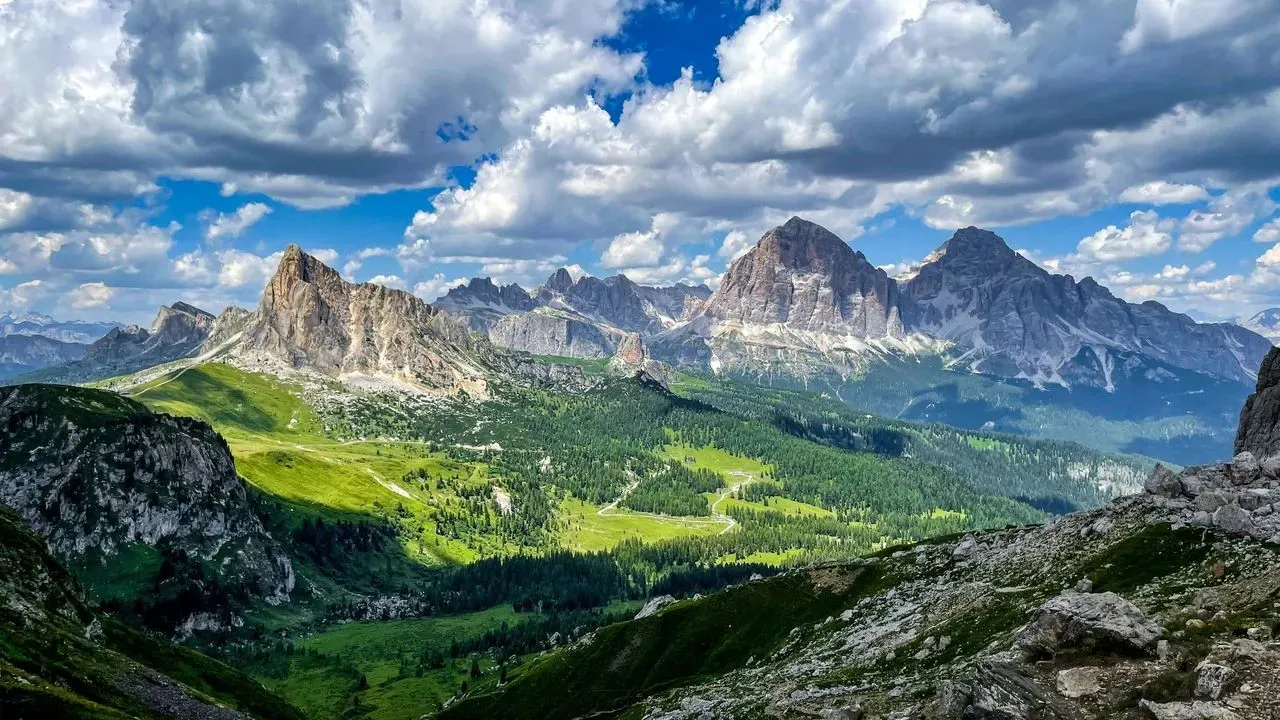

The Dolomites rise sharply in northern Italy, their pale limestone ridges drawing hikers year after year. At dawn and dusk the peaks often take on a rose-pink or amber hue known locally as enrosadira, a natural display caused by the angle of sunlight on the rock. This phenomenon adds a quiet drama to any walk through the range. ([1])
A Landscape Shaped by Time
The Dolomites formed millions of years ago from ancient coral reefs that were later lifted and sculpted by glaciers. The result is a series of jagged towers, broad plateaus, and deep valleys that feel both monumental and intimate. Travelers who arrive in late spring or early autumn often find the trails less crowded and the light especially clear.
Local communities have long maintained paths that connect villages to high pastures and remote rifugios. These routes respect the terrain while allowing visitors to move through it on foot. The emphasis remains on steady progress rather than speed, with many paths marked clearly for day trips or longer journeys.
Following the Light at Tre Cime di Lavaredo
One of the most recognized circuits circles the three distinctive peaks of Tre Cime di Lavaredo. The loop passes beneath sheer walls that catch the enrosadira glow in the evening, turning the stone from white to soft rose. Hikers typically start from the parking area near Rifugio Auronzo and follow a well-graded path that circles the towers in a few hours.
The route offers constant views of the surrounding ridges without requiring technical climbing for most visitors. Benches and viewpoints along the way invite pauses to watch the changing light. Those who linger until sunset often see the full color shift before descending in the fading glow.
Reflections at Lago di Sorapis
Another standout walk leads to Lago di Sorapis, a small alpine lake whose surface mirrors the surrounding peaks. The trail climbs steadily through forest and open rock, revealing new angles of the mountains as elevation increases. In calm weather the water can appear almost turquoise against the pale limestone.
The path is narrow in places and requires attention to footing, yet it remains accessible to fit hikers with proper footwear. Many visitors time the outing for late afternoon so the return coincides with the alpenglow on the ridges above the lake. The experience rewards patience and quiet observation.
Longer Journeys on the Alta Via Routes
For those seeking multi-day travel, sections of the Alta Via trails cross high plateaus and connect a network of mountain huts. These historic paths follow old shepherd routes and offer changing perspectives on the range over several days. Hikers carry only day packs between overnight stops, leaving heavier gear at the rifugios.
The routes pass through varied terrain, from flower-filled meadows in summer to rocky traverses with fixed cables in steeper sections. Travelers are encouraged to check weather forecasts and carry layers, as conditions can shift quickly at altitude. The slower pace allows time to notice details such as the texture of the rock and the calls of birds overhead.
Planning a Respectful Visit
Visitors who prepare with maps, appropriate gear, and awareness of seasonal closures contribute to the long-term care of these trails. Staying on marked paths protects fragile vegetation and reduces erosion on the slopes. Many local operators also offer guided walks that share knowledge of the geology and traditional land use.
The Dolomites reward those who move through them with attention and care. Whether on a short circuit or a longer traverse, the combination of dramatic form and shifting light creates lasting impressions for travelers who choose to explore on foot.
AI Disclaimer: This article was created with the assistance of AI tools and reviewed by a human editor.