

Vienna and Bratislava sit close enough that a single morning train can carry a traveler from one capital to the other, and back again by evening. One recent half-day plan starts with a 9:14am departure from Wien Hauptbahnhof, leaves roughly three and a half hours for the old town, and returns to Vienna by mid-afternoon ([1]). The route suits travelers who want a full, unhurried experience of a second capital without a long transfer or an overnight stay.
Crossing the Border by Rail
The journey is short enough that it rarely dominates the day. Direct REX trains link Vienna Hauptbahnhof with Bratislava, and ([2])notes that they run twice an hour with a journey time of around one hour. Other operators quote a shorter fastest run, with ([3])citing about 44 minutes for the quickest services, so the exact time depends on the train you choose.
Two details are worth noting before you board. Trains serve two Bratislava stations, the main station and the Petržalka station on the south side of the Danube, so ([4])advises checking which one your train is heading to. Fares also vary by booking option. The regional Bratislava ticket bundles the return trip with city transport on the day of travel, and the quoted cost of the full package is in the range of 17 to 18 euros.
| Option | Typical journey | Good to know |
|---|---|---|
| REX regional train | About 1 hour, twice an hour | Arrives at Hlavná stanica or Petržalka |
| Fastest direct service | Around 44 minutes | Timing varies by departure |
| Bratislava day ticket | Covers the return trip | Includes city transport on day one |
Three and a Half Hours in the Old Town
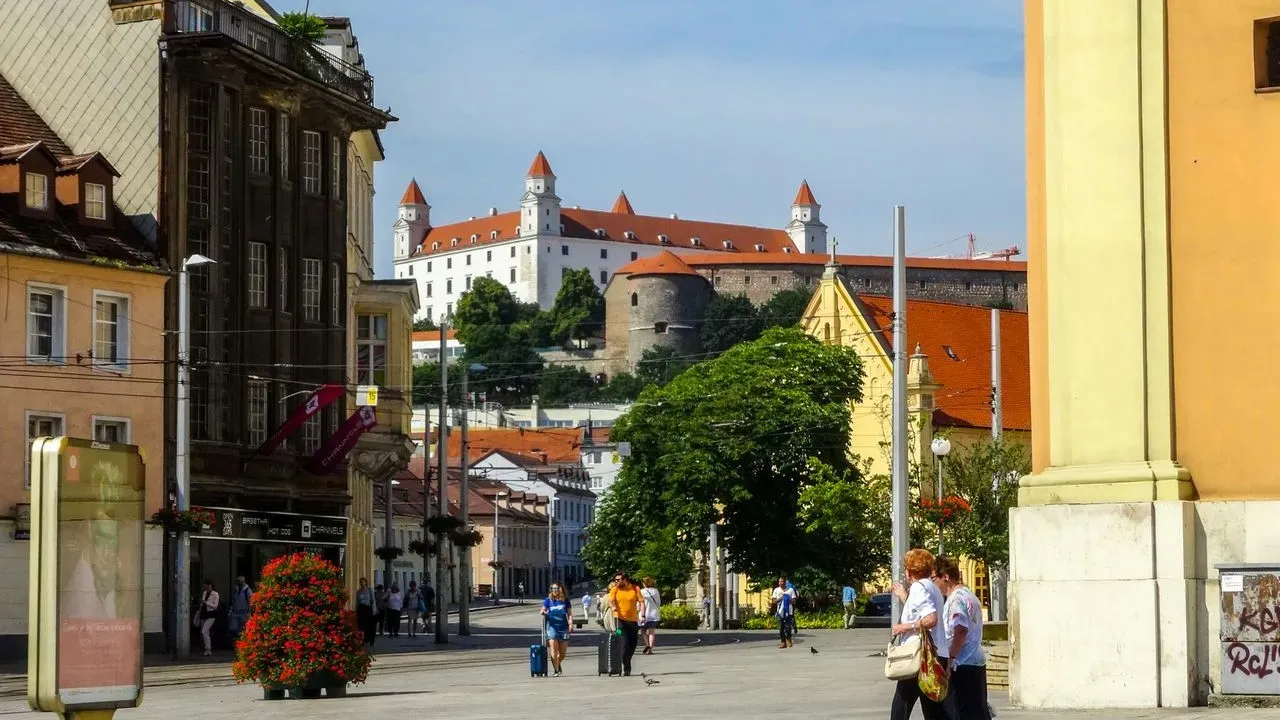
Bratislava’s historic center is compact, which makes a half day feel generous rather than rushed. The Old Town is ([5])a maze of cobblestone streets and pastel buildings, anchored by the Gothic spire of St. Martin’s Cathedral. Many visitors begin at the Main Square, where the Old Town Hall is among the city’s oldest buildings and houses the Bratislava City Museum ([6]). A cannonball mark from Napoleon’s troops is still visible on the Old Town Hall, a small detail that rewards a slow look ([7]).
From the square, a sensible loop continues to Michael’s Gate, the only preserved medieval city gate in the center. For a small fee, visitors can climb its stairs for a view across the Old Town. Along the way, the bronze figure Čumil, a sewer worker peeking out of a manhole, offers a light moment of local humor. This is a part of the city’s postcommunist revival of its historic core that many visitors pause to photograph.
The walk then climbs toward Bratislava Castle, which is perched on a hill above the Danube. ([5])describes the castle as the city’s most recognizable landmark, and its interior now holds the Slovak Museum of History. Allow time for the climb, since the path from the Old Town is steep in places. The reward is one of the most complete views of the river, the old roofs, and the modern skyline.
Stretching the Visit Into a Full Day
A full day allows a more relaxed pace and room for the city beyond its historic core. The Old Town is only the starting point. The Slovak National Gallery is a natural choice for a morning, and ([9])suggests spending mornings at the castle or the gallery, then wandering the Old Town streets in the afternoon. A riverside promenade runs along the Danube, linking the historic center with the newer neighborhood of Petržalka ([9]).
Nature and green space also make a good counterpoint to the stone streets. The Zoological Park and the Botanical Garden lie only a few minutes west of the Old Town ([7]). For those with more time, Devin Castle sits outside the city center. ([8])notes that it works best when a few hours are available, and that transport plans should be checked in advance.
What matters now: Check the timetable for your travel date and confirm which Bratislava station your train reaches. Plan the castle climb for the part of the day when you have the most energy, and leave time to return to Wien Hauptbahnhof comfortably.
A Measured Way to Visit Two Capitals
What makes this trip appealing is not speed but balance. A morning departure, a few carefully chosen stops, and a leisurely lunch can leave a traveler with a clear sense of Bratislava’s character, from its Gothic churches to its riverside calm. The short rail link means the day can be planned around the places that matter most to you, and the return to Vienna still arrives before the evening.
For travelers willing to go a little slower, the two capitals offer a rare pairing: one city of imperial grandeur and one of compact, cobbled charm, reachable in a single morning.
AI Disclaimer: This article was created with the assistance of AI tools and reviewed by a human editor.