

Few states have caused as much head-scratching over something as basic as the time as Indiana. For the better part of a century, residents crossing county lines could find themselves stepping into a completely different hour – not because of geography, but because of decades of competing laws, local defiance, and political stalemate.
This wasn’t a minor inconvenience. It shaped how businesses operated, how schools scheduled classes, and how neighbors on the same street related to one another. The story of Indiana’s clock is, at its core, a story about identity and stubborn independence, dressed up in the language of time zones.
It Started Before Anyone Agreed on Standard Time

Before 1883 in the United States, most towns and cities set their own local time based on when the sun reached its highest point in the sky – and since the sun reaches high noon four minutes later for every degree of longitude traveled west, the time in every town was different. In Indiana alone, local mean time varied from GMT-5:39 in the east to GMT-5:52 in the west. That’s a thirteen-minute spread within a single state. When railroads forced the country toward standardized zones in 1883, Indiana had to pick a side – and it never quite committed.
Congress Placed Indiana on Central Time, Then Everything Unraveled
In 1918, Congress approved the Standard Time Act, putting Indiana in the Central Time Zone. The following year, however, the Standard Time Act of 1918 was repealed. That early reversal set the tone for what would become nearly a century of reversals, overrides, and workarounds.
Ever since the Standard Time Act positioned Indiana in the Central Time Zone in 1918, there was always dispute about what was considered the “official time” within the state. The Interstate Commerce Commission divided Indiana between the Eastern and Central time zones in 1961, but the new time zone line was not consistently observed. The state’s counties varied in observing different time zones throughout the 1960s and 1970s.
Cities and Farms Couldn’t Even Agree with Each Other
Indiana had been on Central Standard Time since 1949, but that didn’t stop most municipalities from putting their clocks forward each summer. Urban areas wanted to stay in sync with economic partners. Rural communities wanted sunrise when it was sunrise. By the mid-1950s, Indiana had a confusing mixture of Central and Eastern standard time and daylight saving time, with each community deciding its own time zone and when to end fast time.
A 1956 Vote That Settled Nothing

A vote was held in November 1956 to determine if residents wanted Eastern or Central standard time, and with or without daylight saving. Eastern Standard Time year-round got the most votes at roughly a third, followed closely by Central Standard Time all year at just over thirty percent.
The state legislature then passed a bill in April 1957 for the third most popular option, Central time with daylight saving, reasoning that Central time had more overall support than Eastern time when the numbers were combined. It was a compromise almost no one had specifically voted for – and it didn’t hold.
Rogue Counties and Illegal Clocks

Perhaps the most remarkable chapter in this story involves counties that simply ignored state law. There were roughly ten counties – five around Louisville and five around Cincinnati – that observed Eastern Daylight Time illegally because they felt more connected economically to Louisville and Cincinnati than to Indianapolis and the rest of the state.
Some observers looked the other way while these renegade counties operated outside official time rules. For the better part of four decades, this informal compromise worked – all of Indiana, save those few counties, was on the same time for seven months out of the year. The other five months were a patchwork that baffled anyone trying to schedule a meeting or catch a train.
The Three-Zone Reality Before 2006

The result was a patchwork of time zones, with 77 counties observing Eastern time but not changing clocks; five on Eastern time unofficially observing daylight saving time; and 10 on Central time that observed daylight saving time. Three separate time arrangements in one state – and none of them were universally accepted as the correct one.
The most extensive study of time zone history in Indiana, published in The American Atlas in 1978, identified 345 areas in the state each with a different time zone history. Three hundred and forty-five distinct time histories in a state that’s about 36,000 square miles. That number alone tells you how granular the confusion became.
The Town Divided by an Hour
Towns straddling the Indiana-Ohio border experienced a particularly absurd version of this problem. For part of the year, residents on each side dealt with two separate time systems – Ohio followed Eastern Daylight Time while Indiana historically followed Eastern Standard Time, meaning two sides of the same community could operate an hour apart.
Local schools like Union Elementary made the issue feel almost surreal. Children on one side of the county line could live under a different hour than their classmates. It wasn’t an abstract policy debate – it affected when the school bus arrived.
The 2005 Law That Finally Forced a Decision

Governor Mitch Daniels pushed daylight saving time in 2005, saying it would end the confusion and promote commerce. Lawmakers passed the measure by a single vote. That margin alone suggests how deeply divided Indiana remained on what the correct time should even be.
Instead of resolving the matter, the vote created a new debate over which time zone Indiana should observe. Eighteen counties asked the Transportation Department to put them in the Central time zone to align with Chicago. The government granted the requests for eight counties, putting a total of 18 on Central time and 74 on Eastern. In 2006, the entire state of Indiana became the 48th state to observe Daylight Saving Time across the board.
The Energy Cost Nobody Expected

When Indiana finally unified its clocks in 2006, researchers seized on the moment as a rare natural experiment. Economics professor Matthew Kotchen and his Ph.D. student Laura Grant, both from the University of California at Santa Barbara, studied over seven million electricity meter readings in southern Indiana every month for three years, comparing energy consumption before and after the change.
Their main finding was that, contrary to the policy’s intent, daylight saving time actually increased electricity demand – consistent with a trade-off between reducing demand for lighting and increasing demand for heating and cooling. The researchers estimated a cost of increased electricity bills to Indiana households of roughly nine million dollars per year, plus social costs of increased pollution emissions estimated between 1.7 and 5.5 million dollars per year. The state had spent decades arguing over time, and when it finally picked one, the economic result was still a surprise.
Where Indiana’s Clock Stands Today

A 2026 bill known as HB 1151, aimed at exempting the state from daylight saving time, is currently pending in the General Assembly, and at least three similar bills failed during the 2025 session alone. The debate, in other words, has never fully gone quiet.
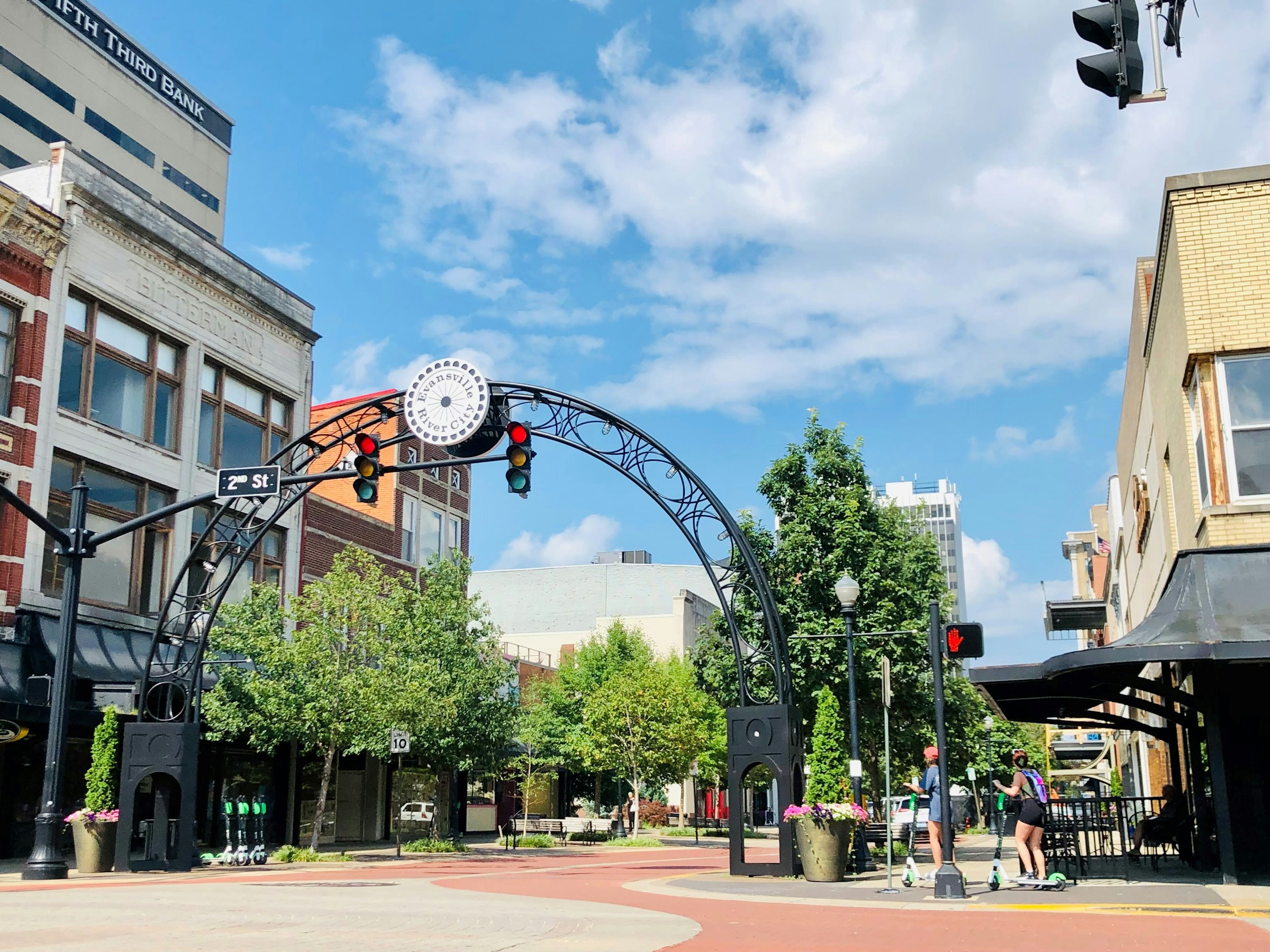
The state remains split between two base time zones – 80 of Indiana’s 92 counties operate on Eastern Time, while 12 counties in the northwest and southwest corners use Central Time. Northwest Indiana functions largely as an extension of Chicago’s labor market, so Lake and Porter counties adopted Central Time to stay in sync with employers and train schedules across the state line. Southwest Indiana around Evansville does something similar, pulled toward St. Louis and the lower Ohio Valley. It’s a practical arrangement, even if it still requires a moment of calculation when crossing county lines.
The Takeaway

Indiana’s time-zone map may look confusing, but it grew through more than a century of geography, commerce, politics, daylight-saving disputes, local identity, and practical compromise. No single bad decision created the mess – it accumulated, layer by layer, across generations of legislators, mayors, and ordinary residents who each had a reasonable argument for why their clock was the right one.
What Indiana’s story really shows is how something as seemingly fixed as time is, in practice, deeply negotiable. The clock on the wall reflects who you’re doing business with, which city feels like home, and who has the political power to make their preference the law. Indiana just happened to make all of that unusually visible for a very long time.
AI Disclaimer: This article was created with the assistance of AI tools and reviewed by a human editor.